Episode Transcript
[00:00:00] Speaker A: As we are about to celebrate Thanksgiving Day, I want to say thank you so much again for your support.
Thank you for your sharing, your liking, your commenting, those kinds of things, your interactions through email and other ways. You have encouraged me, encouraged Josh, encouraged us here at Line Upon Line Ministries to continue doing what we're doing.
God bless you in this holiday. Pray you enjoy this time together with family and friends thinking about all the ways that God has blessed and is continuing to bless you to be grateful for all of these things. Thank you so much.
Thank you to God most of all. Glory, glory be to him. But thank you so much for your faithfulness to, to him and, and for helping us in this ministry. Foreign.
Hello and welcome to another episode of the Line Upon Line Ministries podcast. I'm your host, Mark Williams at Line Upon Line Ministries. We are committed to the expository ministry of the Word for the life of the local church. First of all, I want to say thank you to all of you who have shown your support through following and sharing some of the resources recently. We've had a bit of an uptick this last couple of months and so thank you so much for, for sharing this podcast and sharing the resources that we've shared on Facebook and YouTube and on the website, things like that. We're so grateful whenever we hear stories of people who are just now finding David or who have known him for many years. And so thank you for sharing, for liking, for commenting, doing all those kinds things. Keep that up. We appreciate it very much.
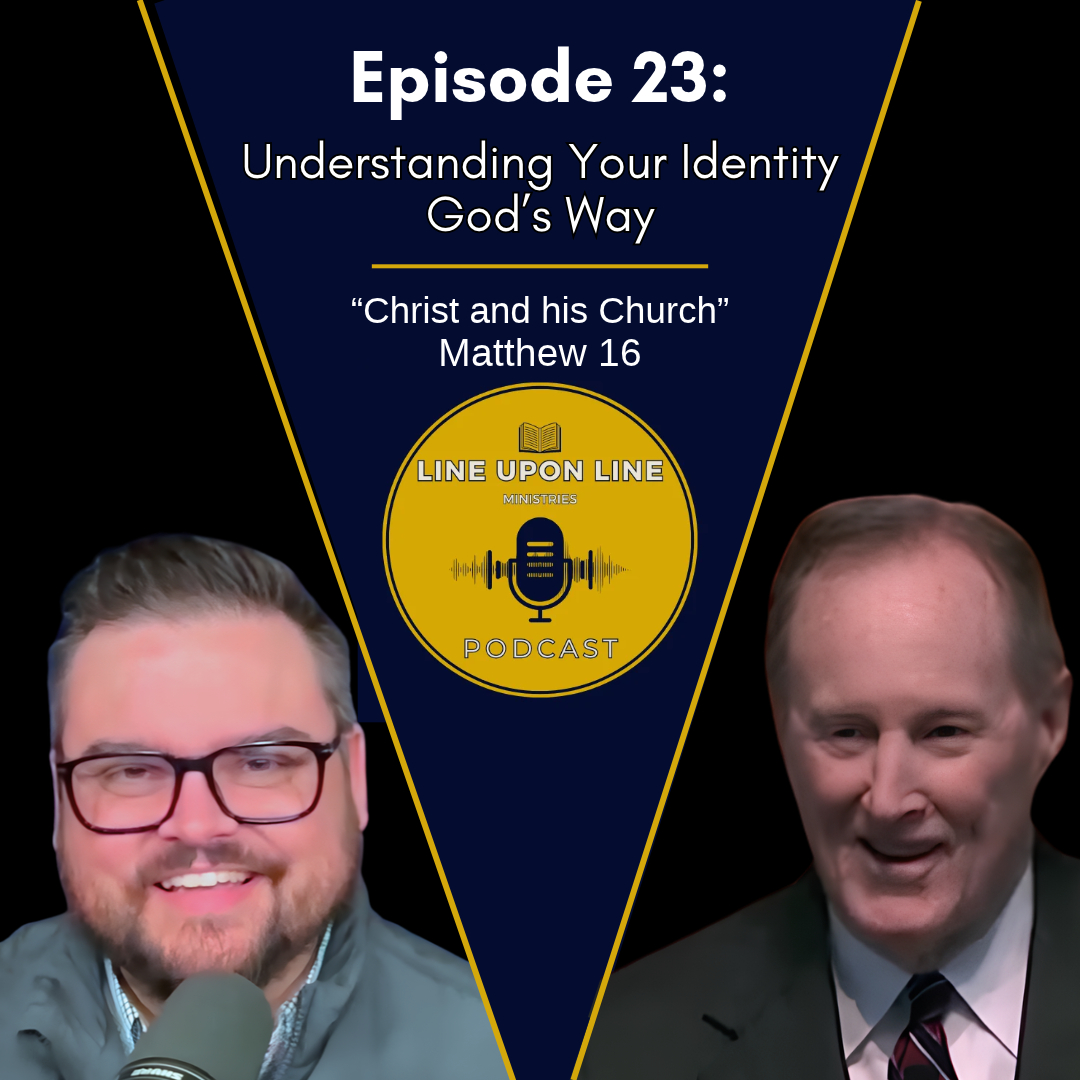
On today's episode, a couple of things for you. First of all, I'm going to share a little bit from my new booklet, understanding your identity, God's way, especially from First Corinthians 6 and the short little phrase and such were some of you and the the importance of that. And of course we also have a classic sermon by brother David Miller, this time on Christ and his church from Matthew chapter 16.
That's just who I am.
I've heard that phrase, maybe not in exactly those words multiple times throughout my own ministry, even maybe even said that myself a time or two.
We usually say something like that after we do something or say something or think something that we know is wrong.
But what is that phrase?
What are we saying about the possibility of change? What are we saying about that, that possibility at all?
I, you know, I've heard things like, you know, I've always just been an angry person.
I'm a failure, you know, or after what happened to me, why should I expect to be any different?
The things we've gone through some of our ideas of growth and of ourselves and of, you know, what we've been through and how we've experienced different things in our life.
Those things are important. Those things are matter. Those things matter.
It's important the things that we've gone through. But. But the question isn't really, you know, what have we gone through? The question is, do the things that we've gone through, do the things that we've heard, do the people that we've learned from the experiences that we've had, do they have the authority in our life to determine who we are and what we can become?
More simply put, who has the right to name you?
And that's what this passage from First Corinthians 6 is all about. And that's why I wrote the little booklet. And this is one of those passages that I've come to again and again and again in my own personal sanctification, but also as I've helped others in recovery, ministry and counseling in the church, things like that.
This is one of those passages you keep coming back to again and again and again. So first of all, let me just read this passage to First Corinthians, chapter 6, verses 9 through 10.
It says, or do you not know, that the unrighteous will not inherit the kingdom of God? Do not be deceived. Neither the sexually immoral, nor idolaters, nor adulterers, nor men who practice homosexuality, nor, nor thieves, nor the greedy, nor drunkards, nor revilers, nor swindlers will inherit the kingdom of God.
First of all, notice here, this book, Letter to First Corinthians, to the Corinthian Church.
If you know anything about the Corinthian Church, if you've read this letter, there's a lot going on in that church, and Paul doesn't skip any of it. Paul calls it out.
God tells the truth about our sin.
I mean, that's quite a list that he just read there. In verses 9 and 10, Paul is addressing a church with serious problems.
In fact, in the same chapter, right before those words, he's talking about how there are people within the church who are defrauding one another. They're, they're, they're wronging one another in, in some of the business transactions that they're dealing with.
And then he says, do not be deceived.
Do not be deceived.
You can end up convincing yourself that your relationship with God is okay, while at the same time you're making excuses for your disobed.
Listen, it is easy to agree with this list when we're thinking about somebody else.
But then Paul mentions greed and reviling the way we handle money and speak to others matters as well.
Paul's not saying that a Christian loses his salvation whenever he sins. He's warning against living the kind of life that's characterized by unrepentant sin.
We can't use the that's who I am excuse to excuse what God commands us to put off, to forsake to these things.
These kinds of people will not inherit the kingdom of God.
He tells us the truth about our sin, but he also tells us the truth about what has changed.
He says in verse 11, and such were were some of you.
Man, those are some sobering and wonderful words. At the same time, Paul is calling out a list that is just overwhelming at first glance.
But then he uses that and especially that one word, such were.
Yes, that was their past. Yes, that those were the kind of lifestyles they lived that described how they were. Their sins were, their identity.
The past was real, but that's who they were.
Their conversion was just as real as their past. Paul knew that these believers still needed correction, clearly read the letter.
And yet at the same time he could speak about their former life as something from which God had rescued them that was no longer who they were. Listen to me, believer. Your past may be part of your testimony, but it is not the Lord of your future. What? What ends up giving a Christian the right to say, that's what I was God.
God has acted. What does he say? And such were some of you, but you were washed.
Notice first of all the but you were washed. That little word, but I love that little conjunction that is actually in the original but you were washed. But you were sanctified, but you were justified. It's there again and again and again because it marks that separation of what you once were.
He says, but you were washed.
Listen, sin brings with it guilt. It brings defilement. You are you. You are a dirty rotten sinner apart from Christ. But then Christ cleanses sinners.
Your regret for your sin didn't remove your guilt.
Hating yourself for your sin doesn't pay for your sin.
I mean, how. How long would you have to punish yourself before you you'd done enough.
There's no way to know that.
And then that's not how it is. Our hope rests in Christ's sufficient sacrifice on our behalf. Forgiveness doesn't erase every consequence that we have to face.
We may need to rebuild trust in broken relationships where we may need to pay restitution where, where necessary. We, we. But we can face those responsibilities as people who have received mercy, who have been washed, cleaned of our sins. Says, but you were washed. But you were sanctified. That word sanctified means you were set apart as his own. You belong to God.
You belong to him now. There is ongoing growth in holiness, but that growth begins with what God has already done.
You pursue then obedience. You pursue sanctification because you already belong to Him. You've already been set apart.
Later on in this chapter, Paul says, you are not your own. You were bought with a price. In verses 19 and 20, listen, your old way of life has no claim to your allegiance. You were sanctified.
And then he also says, but you were justified. God declares the believer righteous on the basis not of their own righteousness, but of Christ's righteousness, which is received according to Scripture, by faith.
Jesus lived in a perfect, obedient life. He bore the judgment that we deserve as sinners, and he rose again from the dead to justify the ungodly. This means that the Christian is not on probation before God.
Our acceptance is in Christ, not in us. It doesn't change with our feelings. It doesn't depend on how well we did yesterday or how well we've done today or how well we're going to do tomorrow.
We still confess our sins and we still receive God's correction and discipline as our, as our Heavenly Father.
But those praise the Lord that are in Christ are no longer under condemnation.
But you have been washed. You have been sanctified. But you have been justified.
But you still may ask the question. Yeah, that sounds great. That still sounds wonderful. But if God has changed me, why do I still struggle?
Because we still battle with indwelling sin, the sin that remains.
Old habits, the old flesh.
We've lived our lives before Christ in separated from him as his enemies for so long that we've created these old habits of the flesh.
They're so much a part of us, it's like second nature.
So temptation to continue to live like what we used to be is very strong.
But listen, the presence of temptation doesn't mean we have to obey it.
Having been saved, having been washed, sanctified, justified sin no longer has dominion over us.
It's still present, but it no longer has dominion.
So we still sin. We can still suffer. We still go through the things that we go through in life, and, and yet those things are no longer our identity.
We can face those things honestly. We can. We can deal with them God's way.
We can Pursue obedience and sanctification and Christ likeness. And we can do so with hope, knowing that our identity is not based on whether or not we've got it right today.
Yes, we struggle. Yes, we suffer. And that is part of the Christian life.
Because you are no longer identified by your sin, your sin becomes a struggle.
That's a good sign.
So now not only can we actually face our sin, not only can we see it God's way, recognize it for what it is.
Now that we have been saved, we can live then as somebody who actually belongs to Jesus Christ. Our identity having been changed has practical consequences for everyday life. Paul reminds the Corinthians here in this passage of who they were because their conduct needed to change.
Did you catch that?
He didn't just go after their conduct. He talked about who they were in Christ before he dealt with what they needed to change.
Think about the person that says, I'm just an angry person.
What does that person need to do?
That person needs to take responsibility, not just keep blaming the fact that he's an angry person on why he continues to be an angry person.
He needs to take responsibility for his own sin. He needs to say, he needs to confess his sin as God says to and do it specifically instead of just go, oh, I'm just, you know, I'm angry. No, I spoke harshly to my wife and that was sinful.
And a believer then takes the next step and asks for forgiveness without adding, but you made me angry.
There's no excuses because he recognizes that he is not identified by that.
To confess it does not mean that's who he is.
To confess it means that's who I was.
But Christ has saved me and he change me now. Now he can examine his heart rightly.
He can ask himself the question, what did I want so badly that I was willing to mistreat my wife when I didn't get it?
And, and, and this person can now who has a new identity in Christ can, can learn to practice what Ephesians 4, 29 commands, speaking words that build up and give grace to those who hear it.
And so then this person who says, I used to be or was an angry person changes the next conversation and more again in the next conversation and the next conversation. The next conversation becomes an opportunity to obey God in this area of his life. And so changing the words that we use about ourselves is insufficient by itself.
You can't just say, well, I'm a Christian now. So no repentance involves changing how we live.
There is work involved. We need to actually take God at His word and obey what he has said. But we can do that now because we are in him and we need help in that process.
That's why we have pastors and more mature believers. We have other people within the church that can help us, walk with us.
So we need to stay involved in the life of the church.
And of course, all of this is dependent in pursuing change and pursuing sanctification out of our identity. All of this is fully dependent on the work of the Holy Spirit as He is in us, empowering us to do all that he has commanded, to trust what God's word says and to carry it out.
When you say that's just who I am, does what follows agree with what God says?
Listen, if you are defending your sin, we need to take Paul's warning here seriously, just as he meant it to the Corinthians do not be deceived.
If you belong to Christ and and you are overwhelmed by your past. Listen, you can also take verse 11 seriously too, and such were some of you. But you have if you have never trusted in Christ, what you need is Him.
Just calling yourself something different, giving yourself a different label is not going to cleanse your conscience. It's not going to reconcile you to God.
You must turn from your sin and trust in the Savior who died and rose again to save you.
So this week, read First Corinthians 6, 9, 11. Identify one area of your life that needs to reflect what God has done for you. What is one area that looks more like what you were and not like what you are?
Begin to work on those things, but doing so not out of guilt or shame, but out of your new identity in Christ.
And that's really what I try to get you to do in this booklet. That's what I try to guide you through in my in my booklet on understanding your identity God's way.
There's scripture passages, practical questions to help you apply these things. Listen to me. You belong to Christ, believer.
And because you belong to Christ by His grace, you and I must learn to live as someone who does.
Now, up next is the classic sermon by brother David Miller on Christ and his church from Matthew, chapter 16. Enjoy
[00:20:16] Speaker B: gave me a very elevated title in his introduction by referring to me as an evangelist.
More accurately, I am a country preacher at large.
I said to a friend of mine, one day I am going to become a country preacher at large.
And he said, david, actually I had ambition early on of becoming a country preacher at large.
But as things have turned out, I'm just A large country preacher.
I was asking my wife one day what she thought about me naming my ministry Line upon Line Ministries.
She reminded me that K. Arthur had already selected that other phrase, precept upon precept.
And then she suggested that perhaps that third line in the passage in Isaiah would be fitting here a little, there a little.
It is a great privilege for me to be your preacher at this time.
I invite you to turn, please to one of the great christological passages in the bible.
Matthew, chapter 16, beginning at verse 13.
I want to talk to you this morning about Christ and His church.
Kind of a catchy title, isn't it?
Christ and His Church.
When Jesus came into the coast of Caesarea Philippi, he asked his disciples, saying, whom do men say that I, the Son of man am?
And they said, some say that thou art John the Baptist, some Elias and others Jeremias, or one of the prophets.
He saith unto them, but whom say ye that I?
And Simon Peter answered and said, thou art the Christ, the Son of the living God.
And Jesus answered and said unto him, blessed art thou, Simon, for flesh and blood hath not revealed it unto thee. But my Father, which is in heaven.
And I say also unto thee that thou art Peter. And upon this rock I will build my church, and the gates of hell shall not prevail against it.
There are two very significant statements in our text.
There is a statement here regarding ecclesiology.
It speaks of the founding of the church.
And there is a statement regarding Christology.
It speaks of the founder of the church.
Dr. G. Campbell Morgan has said that Bible scholars are like sheep.
They like to get together in flocks.
And also like sheep, they sometimes go astray.
And perhaps nowhere is this statement more applicable than with regard to the doctrine of Christ and His church.
Baptists in our day hear many sermons regarding the mission and the ministry of the church, but they hear very few sermons regarding the nature of the church.
A church is a local, visible congregation of Christ's baptized disciples who are united in the belief of what he has said and are coveting to do what he has commanded.
This word ekklesia, the called out, is used in three different ways in the New Testament.
First and foremost, it is used with reference to a particular local visible congregation.
Metaphors are used to describe the church.
Often it is called the building or the Body, or the bride of Christ.
In my opinion, the ideas of locality and visibility are inherent in these metaphors.
For example, did you ever know a universal, invisible building?
Did you ever know of a universal, invisible bride?
I don't know about you, brethren, but I prefer something more tangible in a bride.
Did you ever know of an invisible, universal body?
Sophisticated academic credentials are not required at this point to conclude that when the Bible talks about the church, it's not talking about some universal, invisible entity.
It's talking about a local, visible congregation of Christ's baptized disciples.
The church is made up of the regenerate and the church is made up of those who have been baptized, who are united in the belief of what the Lord has said and are organized and coveting to do what the Lord has commanded.
That's a church, and that's the only kind of church there is.
I like to ask my friends who believe in the universal church, this question.
Where does your church meet.
And who is its pastor?
Benny Hinn, Kenneth Copeland, or worse, Joyce Myers?
Who receives its tithes and offerings?
This universal church of yours, what are its educational and missionary and evangelistic enterprises?
Uh oh.
I've struck a nerve with some of you, and I had absolutely every intention of doing so.
I pray I shall at least provoke your thinking on the subject.
What about this universal church?
Are there any in this august crowd who believe in church discipline?
Have you ever ventured a thought like this?
How could a universal, invisible church implement discipline discipline?
Have you ever thought about this?
If the church is a universal, invisible entity, the local church could go out of business and the universal, invisible church could still be in existence.
What?
Think on these things.
The only church the Lord has is a local, visible congregation.
But now you are aware that this word ekklesia is used another way.
Sometimes it is used with reference to the church in the abstract, to the church as an institution in the generic.
It's used in such a fashion in our text.
When Jesus said to Peter, Thou art Peter, and upon this rock I will build my church, he was not referencing any particular local visible congregation.
He was referring to the church as an institution.
But I want to help you to see that the abstract institution of the church only has expression of its manifestation in a local, visible congregation of baptized disciples united in the belief of what the Lord has said and coveting to do what he commanded.
I shall illustrate my point.
I believe in the family.
Do you believe in the family?
Now, when I make a statement like that, I am not referencing any particular family.
I didn't say my family or your family.
I'm talking about the family as an abstract institution.
I believe in the family.
Now, did any of you, even one of you in this room, think that I was referring to all of the mothers and all of the fathers and all of the children of all of the ages.
Did you think that?
No.
I've got the gift of discernment. You did not think that?
No, not at all. You knew that I was referring to the family as an institution in the abstract that only has expression in a local, visible home where there are parents and children or others who are related by blood or legally.
Isn't that true?
I believe in the jury as a good system of jurisprudence.
Now, when I make that statement, I am referring to the jury as an abstract institution.
None of you in this room thought that I was referring to all of the jurors of all of the ages, did you?
No.
You knew that I was referring to the jury as an abstract institution that only has expression and manifestation of its existence when local jurors gather in one place to hear evidence and give a verdict.
Now, when the Bible says, thou art Peter and upon this rock I will build my church, he's not talking about a universal, abstract church representing all of the saints of all of the ages. He's talking about the institution that has expression and manifestation in a local, visible congregation of baptized disciples united in the belief of what the Lord has said and coveting to do what the Lord has commanded.
But you are also aware that the word ekklesia is used in a third way in the New Testament. It is used in a more comprehensive and inclusive manner.
For example, in the New Testament Book of Ephesians, chapter 5, the Word Church is used in this broader sense, more comprehensive sense.
It's what I call the Glory Church.
Listen to it, husbands, love your wives.
Even as Christ also loved the church and gave himself for it, that he might sanctify and cleanse it with the washing of water by the Word, that he might present it unto himself a glorious church, not having spot nor wrinkle, nor any such thing, but that it should be holy and without blemish.
Let me tell you something about this Glory Church for which Christ died.
Let me tell you something about this more comprehensive, inclusive church.
Let me tell you that that church doesn't exist yet.
That church, that Glory Church, some of its members are already in heaven.
Some of its members are here this morning.
And perhaps, by God's good grace, some of its members have not yet been born.
And yet there is coming a time when the King of Glory is going to descend from heaven with a shout, with the voice of the archangel, with the trump of God.
The dead in Christ are going to be raised first.
We which are alive and remain are going to be caught up together with them in the clouds and to meet the Lord in the air. And so shall we ever be with the Lord. But let me tell you something further about that glory church, that more inclusive, that more comprehensive church, that body of all of the saints of all of the ages. It's only then that we're going to have the general assembly and church the firstborn. But let me tell you further, even that church is not going to be universal and invisible. It's going to be local.
We are going to be gathered around the throne of the Almighty, around the throne of the Crucified One, and we're going to be visible.
The only difference between that church and our church today is our church. The local, visible congregation is organized for celebration and business.
That glory church will be organized only for celebration throughout all the days of eternity.
Now, you can join a fraternity and you can join a civil club and you can become a member of the president's cabinet.
But you can never do any better down here than to be washed in the blood of the Lamb and present yourself as a candidate for baptism. And in that baptism, make a theological statement that you believe in the death, burial and resurrection of Jesus Christ.
Make a personal testimony saying you have died to sin, you have been buried with Christ in baptism, raised to walk in newness of life, and state prophetically in your water baptism that you believe one day, though your body lies cold in the grave, yet because you have been planted in the likeness of his death, you shall be also in the likeness of his resurrection. And by your profession of faith in Christ, Christ and your water baptism, you g up with the Lord's New Testament church on earth. You can't do any better than that down here.
What y' all say? For the life of me, I didn't hear you.
Well, put that aside.
Brother Steve mentioned transitional statements last night.
That was mine.
A lot of guys go to school nearly forever trying to learn how to do this.
For a country preacher like myself, it isn't a problem.
I'm done with that now. Why don't you do this?
All right. This passage also makes a statement regarding Christology.
Three very stupendous statements are made regarding him who founded the church.
First, this text speaks of the character of the founder.
Thou art the son of the living God. What stupendous theological implications in this statement, when these have been carefully considered, it all boils down to Jesus is composed the same stuff that his Father is composed of.
Glenda and I had been married for 13 years.
We had intended to have children but we were always traveling and it never seemed the appropriate time.
At last it dawned on us that if we don't get started, we're going to be Abraham and Sarah all over again.
So we began to pray, and Glinda conceived and our son Joshua was born.
You cannot imagine how much fun my family and our friends had teasing me.
Oh, they said, Joshua is just like his dad.
And they didn't always have my good points in mind.
And I thought about that and I thought, well, why shouldn't he be like his dad?
He's my bone and my flesh.
He's made out of the same stuff that his father's made of.
And when the Bible says that the founder of the Church is the son of the living God, it means that in his essential essence he possesses the exact same characteristics and attributes as his father.
The one who founded the Church has some distinct characteristics.
Let me tell you that he is omnipresent and the heaven of heavens cannot contain him.
He is omniscient, and the haughty and the high minded cannot comprehend him.
He is omnipotent and the host of hell cannot conquer him.
The Mormons may boast of Joseph Smith, but behold one greater than he is among us, Son of the living God.
That's why we don't get together for a pep rally and say, give me a J.
Give me an E.
Give me an S. Give me a U.
Give me an S.
No.
The church comes together in recognition of, in celebration of, in worship to him who is the Son of the living God.
This text speaks of the condescension of the Founder, whom say ye that I, the Son of man am.
This term son of man, was our Lord's favorite term for himself.
It speaks of his passion.
It speaks of his humanity.
It reminds us that though in his essential nature he possessed the attributes of deity, yet he condescended from Heaven's glory and came down to earth shame and in hypostatic union joined his divinity with humanity and became God, dwelling among us in human flesh.
What condescension, bringing us redemption that in the dead of night not one faint hope in sight?
God, gracious, tender, laid aside his splendor, stooping to woo, to win, to save my soul.
Oh, how I love him, how I adore him.
My breath, my sunshine, my all in all, the great Creator became my Savior, and all God's fullness dwelleth in him.
But now this text not only speaks of the character and the condescension of the Founder, it speaks of him as the Christ thou Art the Christ.
You are aware that this word Christ means God's anointed One.
In the Old Testament, three classes of men were prophets, priests and kings.
When Jesus is referred to as Christ, it's not so much a title as it is a designation to office.
In his relationship to the Church, Jesus is our prophet, our priest and our potentate.
And I shall speak further now of these offices.
I would tell you that as a prophet he has convictions.
As a priest he has credentials.
And as a potentate, he has a crown.
I would tell you that as a prophet he is infallible.
As a priest he is impeccable.
And as a potentate he is incomparable.
I would tell you that he, as a prophet is wise.
As a priest he is worthy.
As a potentate he is worshipped.
But I want to elaborate further. Now we're talking about the founder of the Church.
Let me speak further of him as the Church's prophet.
I would begin by telling you that as our prophet, he is conservatively sound in his doctrine.
This man Jesus gave ample evidence that he believed in the historicity of the first 11 chapters, the book of Genesis.
This man Jesus, the prophet of the Church, believed in the literalness and the historicity of the Book of Jonah and even used it as a prophetic reference to to his own death, burial and resurrection.
Back in the late 1980s, the six presidents of the six Southern Baptist seminaries held a meeting in Glorieta, New Mexico.
And after a few days of convening, they issued the Glorietta Statement on the Inerrancy of the Bible and came right out and said that the Bible is inerrant in every area that it addresses.
And all of us shouted out, hallelujah. Praise the Lord. It's about time.
But let me tell the Church something as valuable as the Glorietta's statement on inerrancy might be, we have a more sure word of prophecy.
Jesus himself said, heaven and earth shall pass away, but my word shall not pass away.
Hear ye him.
He's the one who founded the Church.
I would tell you that regarding theology.
This man Jesus was a Trinitarian.
He spoke of the Father, the Son and the Holy Ghost.
He said, the Father is in Me and I am in the Father, and we are one.
Let me tell you that regarding anthropology, he spoke of the depravity of the human heart. He told us that men are dead spiritually and cannot activate themselves.
They are defiled morally and cannot rehabilitate themselves.
They are dominated satanically and cannot liberate themselves. They are debilitated volitionally and cannot elevate themselves, and they're damned eternally and cannot exonerate themselves. They can't work their way or worship their way or will their way to the Father. They are dependent upon the interposition of the grace of God in Christ Jesus, or they'll die and go to hell.
Let me tell you that regarding soteriology, the prophet of the Church, the one who founded the Church, has said, I am the way, the truth, and the life, and no man cometh unto the Father, and but by Me.
As far as the profit of the Church is concerned, there's not going to be anything general, vague, nor indefinite about the atonement which he would make at Calvary. Rather, it would be a definite atonement, accomplishing particular redemption for all of those whom the Father had given him, and of those, not one shall be lost.
Are y' all getting any of this yet?
Do you know what I might do if I got to thinking you weren't getting this?
I'd stop and go back and repeat every single word.
I'm talking to you now about the one who founded the Church, our prophet.
Let me speak of him as our priest.
Let me tell you this about him.
He is not after the order of Levi nor Aaron.
He is after the order of Melchizedek, has no beginning and shall have no end.
Let me tell you further that unlike all of those other priests who preceded him, this man Jesus does not need to make sacrifice for himself, seeing he is holy, harmless, separate from sinners, and higher than the heavens.
And he, through the eternal Spirit, has entered into the holy place in the heavens, not with the blood of bulls and goats, nor the ashes of an heifer, but with his own blood.
He has sprinkled that blood upon the mercy seat.
And he now is able to save them to the uttermost which come to God by Him, seeing he ever liveth, to make intercession for them.
Let us come boldly into the very throne room of God through Christ our priest.
Come with confidence that we shall gain an audience with the Almighty and find grace to help in time of need.
But let me speak briefly of him as potentate of the Church. Church.
Just because you deacons get together and vote on it doesn't mean it's permissible.
Let me tell you, the money can be in the bank for the project.
But until you've prayed and sought and gained the permission of him who died for the Church, you have no right to proceed.
But let me tell you further.
One of these days we shall see him coming in the clouds with all the holy angels and he shall divide the sheep from the goats I can hear the chariots rumble I can see the marching throng and the flurry of God's trumpet Spells the end of sin and wrong Regal robes are now unfolding Heaven's grand stand all in place Heaven's choir now assembled Start to sing Amazing grace oh the king is coming, the king is coming I just heard the trumpet sounding and soon his face I'll see the king is coming, the king is coming Praise God, he's coming for me
[00:59:17] Speaker A: I hope you've enjoyed this episode of Line Upon Line Ministries Podcast.
Be sure to check out our socials, go to the website, do all those kinds of things. If you have any questions or comments or you happen to have any material from Brother David Miller, maybe he preached at your church or you heard him somewhere, you saw a clip somewhere. Love for you to send that to us to make sure we have that.
Lineuponlineministriesmail.com is the email address. Love to receive any of that from you.
Finally, as we are about to celebrate Thanksgiving Day, I want to say thank you so much again for your support.
Thank you for your sharing, your liking, your commenting those kinds of things, your interactions through email and other ways. You have encouraged me, encouraged Josh, encouraged us here at Line Upon Line Ministries to continue doing what we're doing.
God bless you in this holiday. Pray you enjoy this time together with family and friends thinking about all the ways that God has blessed and is continuing to bless you to be grateful for all of these things. Thank you so much.
Thank you to God most of all. Glory, Glory be to Him. But thank you so much for your faithfulness to to him and and for helping us in this ministry. And as always, God bless you as you continue to study and minister His Word. Line up.