Episode Transcript
[00:00:00] Speaker A: I mean, you, you know, you can't talk about Brother David Miller for very long without having to talk about Bill Williams.
In fact, you know, Josh, you know, the other day when we were, when we sat down together and talked, you know, he mentioned that, you know, very likely there wouldn't be a Line Upon Line Ministries.
[00:00:18] Speaker B: Yeah.
[00:00:19] Speaker A: If it wasn't for Bill, if it wasn't for him coming alongside David and going out together, this, this ministry wouldn't exist.
[00:00:28] Speaker B: Yeah.
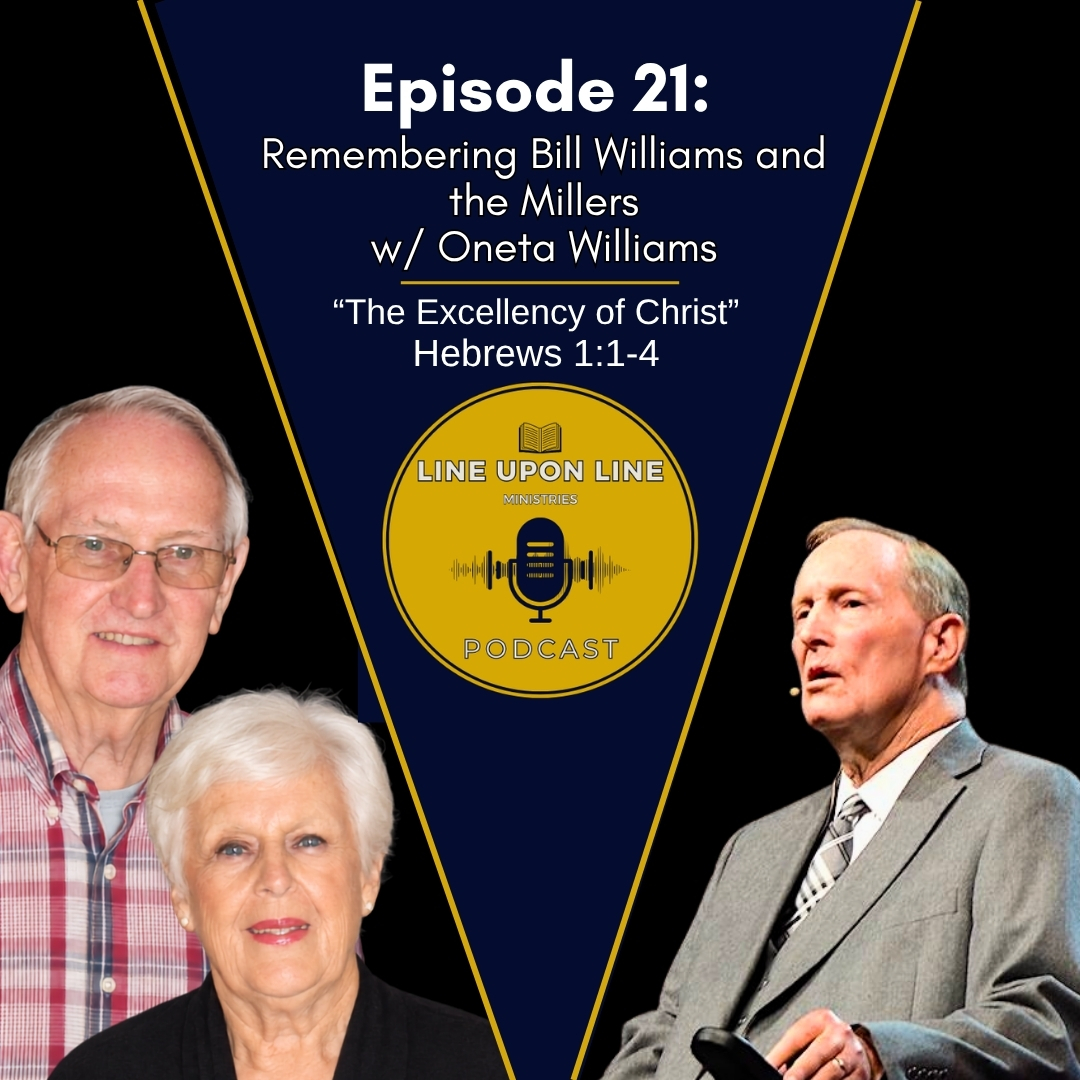
[00:00:39] Speaker C: Hello and welcome to another episode of the Line Upon Line Ministries podcast. I'm your host, Mark Williams. Before we do anything else, I would like to announce the release of our brand new book of sermons by Brother David Miller. This one's called Contending for the Faith. It is out now. It's so new, I don't even have a, a real copy of it yet. This is still the, not for resale copy, but if you're watching this podcast or you're listening to this podcast, it is out right now, you can order it on Amazon. You can find the link to that in the description or on our website or wherever it is that you are watching or listening to this on. And so very excited to see the second one. You guys supported us on the, the first release, the first book release on the doctrines of grace. And so we're excited to provide this next book as well. Well, on this episode, we have a couple of exciting things for you. First of all, we're going to be sharing the first part of an interview that I had with Ms. Oneita Williams.
Ms. Oneita Williams was married to Brother Bill Williams, who was instrumental in founding and doing the work of ministry in Line upon line from its inception. And so you can hardly, as you saw at the opening clip, can hardly talk about line upon line without Bill Williams name coming up fairly quickly. And so we had the opportunity to sit down with her and have her share insights and stories of their relationship with the Millers. We also have another classic sermon by Brother David Miller. This is one of my favorites, one that he preached at G3, actually a couple of different times. It's the Excellency of Christ from Hebrews chapter one. And before we get to the interview, just a quick reminder, check out our website, our Facebook, YouTube, all of those different things. If you're not following along, follow like, share.
As you find different resources that we post encouraging, please share those with your friends or family that helped go a long way to spread the word.
And now let's get to the interview.
Ms. Oneida's husband, brother Bill Williams, spent years in ministry with brother David and was, was a dear friend and like a brother to him.
Bill and Oneita's friendship with, with David and with his wife Glenda, their son Josh, was more than just ministry.
They were like family. And so I know a lot of our listeners know Brother David through the sermons that we're preserving through the sermons and clips and things that we're sharing through line upon line ministries. But in this interview, we're going to talk about who brother David was away from the pulpit, how he was with brother Bill, and spend time talking about their friendship, not just between these two men, but between their families. So I hope you will enjoy this first part of the interview with Ms. Oneita Williams.
Well, Ms. Oneita, thank you for taking
[00:03:54] Speaker A: the time this morning and sitting down with me. I know we've been talking about this for a little while about getting you in here.
Your husband, brother Bill, was a longtime friend of David and spent some time in ministry with him. And so you and David and Glenda and the Miller family have been good friends for a long time. So you bring a perspective that I think a lot of our viewers, our listeners would appreciate because you knew David and Glenda not just as David Miller, the preacher. You know that guy, you knew him that way, but you knew him as a close friend. I mean, Josh still calls you Ann Oneida. And so you guys, your closeness is something that I think a lot of people will appreciate. And so some of your insights and stories will be, will be nice to hear. So before we, we get into anything about David and Glenda and the Millers, I'd like to get to know Bill more, hear from you about him. So tell us a little bit about brother Bill Williams and what was he like?
[00:05:06] Speaker B: Well, Bill Williams was a, was a great person.
He was born and raised in Jacksonville, Arkansas.
He was, his parents were, well, his father was a carpenter and his mother, well, she worked, she stayed at home when, when the kids were smaller and she went to work for the Horner Box Company and worked there for years.
And Bill's dad passed away when he was only 47 years old.
So Grandma, we called her, you know, had the kid. Well, Bill and I were already married when he, when he passed away. But anyway, they, he grew up in the assembly of God Church and his, his dad and all of his dad's brothers were musicians. They all played an instrument.
Bill never did play an instrument, but he did have the voice and he sang and his, his parents both sang.
And so he brought, he, you know, he grew up in that.
And his aunts and uncles were real close. His uncles would get. They were. Some of them lived out of state, and they would come in every so often. They'd all get together and play their instruments and sing. So that was just part of his life, you know, all of his life.
And we. He went to Jacksonville schools, and my family and I moved to Jacksonville when I was in the third grade. So Bill and I were in school basically, you know, in the same school. All through school, we only had one class together, and that was civics in the ninth grade through all of that.
[00:06:50] Speaker A: But we're in the same grade. Or is.
[00:06:53] Speaker B: We were in the same grade. No, no, he's. He's from July to October older than I am.
[00:06:59] Speaker A: Okay.
[00:06:59] Speaker B: But yeah, we were in the same grade, graduated the same year, went to college the same year. He went to college at UCA as astc, then on a football scholarship, and that lasted just a little while. And after football season over, he was through school, basically. So he dropped out the next semester and then went back the next year and went. And then decided, you know, college just wasn't for him. So he quit college and went to work at Horner Box.
But growing up through school, you know, he was. He was always athletic. He played football, big football star, baseball was. Big baseball. And had. Was about to try out for one of the major leagues, and he. He was a pitcher, and he threw his arm out of place. So that ended that.
But anyway, all through school, you know, we attended, you know, all kinds of athletic functions.
And people always talk about going to the movies and going to the movies, you know, and what they saw at the movies. We never did have time to go to the movies. We were always sporting. Sporting events. So, you know, that's. That's kind of what his childhood and his teen years and his young adult. Well, he played softball as long as he could. He probably was 50, maybe the light in his 50s the last time he played ball on a team, you know, so that was just part of his life.
[00:08:31] Speaker A: I wouldn't have guessed he was an athlete.
[00:08:34] Speaker B: Well, he was, yeah, and he was a good one. And he. And the coach he had in high school made him participate in all sports.
So football. Football was his sport. He played football, basketball, he was on the team. But when they wanted somebody roughed up a little bit, that's when they put Bill in.
And then track, of course, he was not track, but the coach made him run, you know, and he said by the time he rounded the track, they were already setting up the hurdles for the next event, you know, so, you know, that was not his sport, but
[00:09:09] Speaker A: he had a run. So you can build up endurance for football.
[00:09:12] Speaker B: Yeah, no, he just made it. He just made him participate. He just made him participate in all sports, you know, and want to get a feel of it to see if they really liked it, you know, and keep them active, I'm sure, because back then, you know, you didn't have multiple coaches, you know, you know, for each sport.
But we had, you know, that was our high school years. Then we went off to college. Like I said, both went to what was astc then that didn't last long for him. And he went to work for Horner Box, and he worked there for 10 years.
And we had the girls and we had.
We had bought a house, I think by this time, because Carla was a year old when we bought a house.
And he was working at Horner Box. No, by then he had gone to work for Arkmo Lumber and he worked there.
And then the Lord called him into ministry when he was maybe 35.
And so then he worked at Horner Box.
He part time.
He worked at the church. He led music and cleaned the church. And this at Highway Baptist Church.
And then he went to a seminary part time when it was in Little Rock.
[00:10:36] Speaker A: The Mid America.
[00:10:37] Speaker B: Yeah, Mid America. He went there when it was in Little Rock. He went.
He went to school half a day, then he worked half a day and then he worked at the church and then he tried to study in his spare time, but. Yeah. And so then, then the seminary moved to Memphis. And so he and three other guys would drive over on Tuesday morning. They had this little duplex and they all stayed in. And Bill was the cook. There's none of the rest of them could cook.
And he was the cook. And they stayed until after classes on Friday and then came home. Then they did all. They were all in ministry, so they all did their, you know, church were. All of them were pastors except Bill. He was a music minister and youth director.
So that was.
We did two years of that.
[00:11:32] Speaker D: Wow.
[00:11:33] Speaker B: And Carla was like in third grade and she'd cry every night, every Monday night, you know, daddy, why do you have to go? You know. And then that was your, you know, third grade was a year they had to learn their multiplication facts.
Well, she was bound and determined. There had to be an easier way to do that. Then memorize them. And she'd go through the whole line. Well, how did Daddy learn them? How did mom, how did you learn. How did Kim learn We memorized them just like you're going to have to. And so, you know, we. We dealt with that. And of course, you know, him not being there, you know, during their early years, you know, all the time, you know, they. They missed him.
[00:12:16] Speaker A: Sure.
[00:12:16] Speaker B: And.
But anyway, you know, he. Of course he coached softball coach. Both of them softball teams all the way up, even after they got out of high school.
So, you know, like I say, he was.
[00:12:30] Speaker A: He stayed in sports.
[00:12:31] Speaker B: He stayed in sports as long as he could. Yeah. As long as his body was letting. Yeah, right. And then he developed, you know, rheumatoid arthritis or thought we. Anyway, sure. So.
[00:12:44] Speaker A: So he was called into ministry, went off to seminary.
How many years was he in seminary? Two or three years.
[00:12:50] Speaker B: Three years. He did a year in Little Rock and two in Memphis.
[00:12:53] Speaker A: Okay, so he got the. Did an M. Div. There or is that a.
[00:12:56] Speaker B: No, he. It was a diploma because of his age and he didn't have a college degree back then. I don't know if they still have that or not at Mid America.
[00:13:05] Speaker A: Sure.
[00:13:05] Speaker B: Either they had what they call a diploma.
[00:13:08] Speaker A: Okay.
[00:13:09] Speaker B: It was basically the same thing, you know, except you didn't have to write the thesis and things, you know, at the end. But, you know.
[00:13:17] Speaker A: So then after, after that, what did ministry look like for Bill from that. That point?
[00:13:21] Speaker B: Well, he was, like I said, he was the youth and music at. In Highway. And then when he was about 35, the Lord called him into the preaching ministry. Okay. And we, we.
Highway started a little mission out from Jacksonville called Military Road Baptist Church or Baptist Mission back then. It's church now.
And he, we. We started that a little. Small.
Small, little.
It was like a house like thing.
Now they've got a real nice facility.
[00:14:00] Speaker A: Is that still mission, still military?
[00:14:02] Speaker B: Military Road, Yes.
[00:14:04] Speaker A: Wow.
[00:14:05] Speaker B: Yes, it is.
[00:14:06] Speaker A: So he went from Military Road to Quitman, the next place.
[00:14:11] Speaker B: And Quitman called him in 1980. We moved there in June of 80 after school was out.
And he ministered there until David was, you know, associational missionary for Little Red River.
And somewhere along the way, you know. Well, he did revivals, you know, traveled a little. This was back when he could still drive and Linda could go with him, you know.
And this was before Josh came along.
[00:14:44] Speaker A: Right.
So.
[00:14:46] Speaker B: So this was.
So, you know, she did that.
And then the Lord laid on his heart to do.
He called it itinerant missionary work.
Mission. I mean, what do you call it?
[00:15:01] Speaker A: I tear it like preaching.
[00:15:02] Speaker B: Preaching, yeah.
[00:15:03] Speaker A: Evangelism.
[00:15:04] Speaker B: Yes, evangelism.
And so he.
Bill started. He resigned at Quitman. And there's like a little interim in there that he really didn't, David didn't have a whole lot for him to do. Didn't have funds to pay him. So we went back to highway and he did a little work there, you know, for a while until he started working and he did. Then he started working with David with some of the sensational work.
And, you know, he always helped him with the camps, you know, summer camps was a big deal.
And we really, you know, we all really enjoyed it all.
We, you know, Josh went when he was little.
[00:15:53] Speaker A: Right.
[00:15:54] Speaker B: Our girls went when they were young.
[00:15:56] Speaker A: I think we're still going to the same camp, I think. Right.
[00:15:58] Speaker B: Well, it's the same, it's still the. No, it's not the same place. We went to Lonsdale down south of Benton.
[00:16:08] Speaker A: Okay.
[00:16:08] Speaker B: Toward Hot Springs.
It was a, it was an old, old, old gyms where it started and they had dorm rooms on each side. Now it's. None of the facilities that are, were there then are still there because we went a few years ago just to see what it looked like. And there was nothing, nothing like.
But that was, that was some great years, you know, for us.
[00:16:35] Speaker A: So at what, what point in all that there, you know, those, those first early mission or ministry years did you guys first meet David?
[00:16:45] Speaker B: We met David in 1975. He came to highway.
[00:16:49] Speaker A: Okay.
[00:16:49] Speaker B: He and our pastor, Larry Ballard, were friends I had met years before.
And so Larry had him there for revival and we met him, had him in our home and, you know, we just hit it off. Yeah. And then David started inviting us up, you know, for just different things.
And then he invite Bill up to preacher leave music at some of the smaller churches around in association, and he
[00:17:18] Speaker A: just kind of fill in room, you know. Well, not kind of, kind of stuff.
[00:17:24] Speaker B: Well, he would just supply, you know, just occasionally and so that we just, I don't know, our families just kind of bonded.
[00:17:32] Speaker A: Yeah.
[00:17:32] Speaker B: And just got closer and closer.
[00:17:38] Speaker A: Yeah. So what, what was, what first was your first, like, impression of David, the first time you guys met him or saw him?
[00:17:46] Speaker B: Well, you know, David, when we first met him was still walking, right. With his cane and he was still driving that little Bug, still driving that little yellow Volkswagen. And he, he'd come pick Bill up in that yellow, little yellow Volkswagen and he would drive.
And back then, David was still playing ping pong. You know, they had, where their house is. They, it had a carport and he leaned up against the wall. They had the ping pong table out and the carport.
[00:18:15] Speaker C: Right.
[00:18:15] Speaker B: And they play ping pong out there.
[00:18:17] Speaker A: Yeah, I can't picture brother David playing ping pong. So that.
[00:18:23] Speaker B: Oh, he was wicked with it.
[00:18:24] Speaker A: That's what I hear. I've heard stories that he was.
[00:18:27] Speaker B: It was hard to beat him.
[00:18:28] Speaker A: It was quite a ping ponger. I don't know if that's the right, right term for it.
[00:18:32] Speaker B: Anyway, he was good at it.
[00:18:35] Speaker A: So. So, I mean, it didn't take long for you guys to get connected, you know, with David and Glenda to really become close friends.
Obviously, Bill, you guys came up to Quitman, which was closer to where they were and part of the association.
So after Bill left Quitman and filled in, like you said, for a little
[00:19:01] Speaker B: bit of time, he just did various things, you know.
[00:19:05] Speaker A: So when did, when did that really become more of a specific. Like when did line upon line, like Bill and David work together? Like, when did that take really, really get started?
[00:19:17] Speaker B: Well, they work some together after Bill resigned. 85, they do, you know, a few meetings here and there, you know.
But then Bill started traveling. I mean, they started traveling. I can't remember what year David resigned from being associational missionary, but at that time, then they started traveling, you know, full time. And I remember the first motorhome David bought.
I took Bill to Little Rock or Northern Rock. Can't remember where it was, you know, for them to get on the motorhome and take off for their first trip. Then they got all the way to Texarkana and the thing messed up on them.
So somebody in that area, David knew, some pastor of course, loaned them an old car and they drove on to wherever they were going in Texas for the meeting.
So, you know, and of course with the motorhome and that, you know, they have all kinds of tales to tell,
[00:20:19] Speaker A: I'm sure, I'm sure.
[00:20:20] Speaker B: And one time they were going out west and they went into a snowstorm and so they. I mean, it was just him. You know, they pushed on as long as they could in any kind of weather.
I mean, that's just the way they did.
[00:20:38] Speaker A: Right.
[00:20:39] Speaker B: And anyway, they got the point.
David, we can't go any farther. We have to do something. So they pulled off at this gas station and I don't know if they were able to park under or. So anyway, they were able to stay in the motorhome.
And I think there was someone there at the gas station, made them coffee. And anyway, there's other people there too. So of course I just intermingled with them, you know, wrote it out.
So.
[00:21:11] Speaker A: So Bill. Bill and David, they got together, started working together, going out and doing. Doing line upon line, I guess, you know, preliminary. Did they call it line upon line early on?
[00:21:22] Speaker B: Was it.
[00:21:22] Speaker A: And so it's been that for. For all that time. It was like around 85, I think. Is what.
[00:21:28] Speaker B: Something like that?
[00:21:28] Speaker A: Yeah, like that. And, you know, so they. So they. They were together now.
What. What did that look like? Like, was. Was it just that Bill was there to. To. To. To support David or was what.
[00:21:42] Speaker B: What.
[00:21:43] Speaker A: What part did Bill play? What part did David play as they
[00:21:46] Speaker B: went out together, as they traveled or as they worked in churches or what?
[00:21:49] Speaker A: Yeah, both. Like what?
[00:21:51] Speaker B: Okay. Of course, you know, he traveled with him, you know, did that, driving, all that, took care of David's personal needs, you know, did all of that and led the music in meetings.
[00:22:03] Speaker A: Yeah. And did he write his own stuff or did he lead hymns? Was there.
I mean, what was, what was his. What was Bill's, you know, preference there on leading music at those meetings? Did he have one or was it just sort of.
I mean, it was wanted or did he have.
[00:22:24] Speaker B: Well, I mean, he would always ask the church if they had no preference in, you know, he did his. On, you know, and of course, they always wanted him saying special.
And then, you know, and then he just took care of David. Of course, when, like I said, you know, when he and David first traveled, started traveling, he just helped David up, and then David could walk to the pulpit.
And then.
And I forget what year it was. 1990, I think David fell.
I think it's New Year's Eve or New Year's down.
Down in South Arkansas somewhere. He fell. And that's when he said he's gonna have to give up his pride for the ride.
[00:23:09] Speaker A: And that's when he moved into a wheelchair more permanently.
Yeah.
[00:23:14] Speaker B: Yeah.
[00:23:15] Speaker A: Was that.
I don't know if I'm remembering the story correctly, but was that during a revival meeting? Yes, he was preaching when he.
[00:23:24] Speaker B: Well, no, Bill was getting him up and he stood. Yeah, when he stood up and his legs just wouldn't hold him up.
[00:23:30] Speaker A: Just came out.
[00:23:30] Speaker B: Yeah.
Yeah.
[00:23:33] Speaker A: So. Yeah, from 1990 on, I think it was 90. Yeah, around 90, he was. He was in the wheelchair. And so, you know, so Bill was. Bill was with him from 85 to about 2000, I think he told me before.
And so from 90 to 2000, it was. It was even more of a. Having to take care, you know, pushing him around. Or did he have an electric wheelchair at first or was it.
[00:24:00] Speaker B: No, not at first.
[00:24:01] Speaker A: Okay, so Pushed him around, making sure he got everywhere he needed to go.
[00:24:05] Speaker B: Up and down stairs, all this.
[00:24:07] Speaker A: You know, I'm sure that changed vehicles, changed a bunch of different things that they had had to do to accommodate.
[00:24:15] Speaker B: Right.
[00:24:15] Speaker A: You know, this new, new, new normal.
[00:24:19] Speaker B: Right.
[00:24:19] Speaker A: David.
And so Bill was there during all that.
[00:24:23] Speaker B: Right.
[00:24:23] Speaker A: It was part of.
[00:24:24] Speaker B: Right.
[00:24:24] Speaker A: Helping David get, get established in this new kind of, kind of thing.
[00:24:29] Speaker B: You know, Bill, did. Bill work for him, you know, when they weren't out on the road, Bill worked for him doing whatever, you know, he had to do around here. And of course, you know, David had a. Had a place down in Mississippi, the deer camp.
[00:24:45] Speaker A: Yeah, Deer Camp.
Stories about that.
[00:24:48] Speaker B: The deer camp was very rough to begin with. I mean, they just, I think they had a tent.
[00:24:54] Speaker A: Wow.
[00:24:56] Speaker B: If I, I can't really remember what I'm trying to remember.
[00:24:59] Speaker A: That was just the beginning of it.
[00:25:00] Speaker B: Yes. And it was rugged. Oh, it's awful.
And then, you know, eventually David built a real nice cabin down there.
Two, two story. And we go. And we'd stay on the bottom floor and David and Linda. Because it. Well, David could get in either place. Either place was wheelchair accessible. And we'd go down there when they'd hunt.
[00:25:24] Speaker A: So you, you've been down there?
[00:25:26] Speaker B: Oh, yes.
[00:25:27] Speaker A: Okay.
[00:25:27] Speaker B: And we'd ride four wheelers and you know, and they'd hunt and.
[00:25:31] Speaker A: Yeah.
[00:25:32] Speaker B: Work.
[00:25:33] Speaker A: Do a lot of work.
[00:25:34] Speaker B: Do a lot of work. And you know, David and Bill were more like brothers. You know, they just fuss and fight and you know, and he, of course, he, he didn't call him. David didn't call Bill, Bill when they were out like that. He called him Willie.
And now Willie, you say, and let's don't do it that way.
And then Bill would argue with him, say, well, David is not going to work that way, you know, and they were just like, like I said, they were like brothers. They'd fuss and argue and carry on. Yeah.
[00:26:06] Speaker A: Were they. Were they more alike or more different?
[00:26:09] Speaker B: They had some similar ways and other ways. You know, they were kind of butt
[00:26:14] Speaker A: heads a little bit.
[00:26:15] Speaker B: Oh, yes. Oh, yes.
Oh, yes.
[00:26:18] Speaker A: Like any good brother would.
[00:26:19] Speaker B: Like any good. Well, anybody that would stand up to David would butt heads with him. So now, you know. But most people, they were scared of him, I guess. I don't know. But, you know, and some, you know, just looked up to him and they thought that would be. Not be wise to.
[00:26:40] Speaker A: Sure.
[00:26:41] Speaker B: Question him.
[00:26:41] Speaker A: Yeah, that's. That's the David Miller, you know.
[00:26:44] Speaker B: Yeah, yeah.
[00:26:46] Speaker A: You don't mess with David.
[00:26:47] Speaker B: Yeah. Bill did, but Bill did. Yeah. Build in.
[00:26:51] Speaker A: He had that. That kind of closeness where he could.
[00:26:54] Speaker B: Oh, yeah.
[00:26:54] Speaker A: Well.
[00:26:54] Speaker B: And to see anybody else that traveled with David after that were younger.
[00:27:00] Speaker A: Yeah.
[00:27:01] Speaker B: Except Bill.
Bill, I think, anyway. You know, he traveled with him, I think, about a year maybe.
But, you know, they just never did have the relationship that Bill and David did.
[00:27:14] Speaker A: Yeah.
[00:27:15] Speaker B: Younger guys looking and then the younger guys.
[00:27:17] Speaker A: Yeah.
[00:27:17] Speaker B: They knew better.
[00:27:19] Speaker A: Right.
They knew what they were there to do.
[00:27:22] Speaker B: They did.
[00:27:23] Speaker A: And they. And they did. And they took care of him in that way.
[00:27:26] Speaker B: And Bill had worked with him so long that he knew, you know, the things to do and things not to do.
[00:27:31] Speaker A: Sure. And yeah, they got to know each other well enough to be able to do that. I can see that.
So what was.
What was it like from your perspective, you know, being just. Just being friends with David and Glenda?
[00:27:47] Speaker B: What was that relationship and being a widow a lot?
[00:27:50] Speaker A: Well, yeah, I mean, that's. Let's just be honest. When Bill and David were gone, you and Glenda left behind, so.
[00:27:58] Speaker B: Well, my girls were already, you know, grown.
[00:28:02] Speaker A: Sure.
[00:28:03] Speaker B: So I didn't have that. Glenda had to deal with Josh, you know, a lot. And Josh, if anybody knows Josh knows he could be a pill.
And that's the reason David, Glenda quit traveling with Dav when Josh was about 2, because he just out, you know, in hotels and they didn't have the motor home. Then they would stay in motels and hotel. And Josh just got tired of that.
[00:28:26] Speaker A: Yeah.
[00:28:27] Speaker B: And he'd, like. He'd rather be out wandering the woods, you know, whatever. And that was just not his lifestyle.
[00:28:33] Speaker A: Yeah.
[00:28:34] Speaker B: And it was decided that it was best that she just stay home. Keep that little booger at home.
[00:28:39] Speaker A: Sure.
[00:28:40] Speaker B: And let David find somebody, travel with him and.
And go on about his work.
[00:28:45] Speaker A: Right.
So what was your relationship with. With Glenda like?
[00:28:49] Speaker B: Oh, Glenda and I were like sisters.
My sisters both lived up north, so, you know, I didn't see them very much. Glenda's sisters. One lived off.
Well, they both lived. Didn't live here. And so, you know, we. We just. If we needed something or we'd go to places together. We did a lot of things together, you know, and when she do the older. Like the Christmas dinner she always did for pastors, you know, she used to do it in their home.
[00:29:20] Speaker A: Yeah.
[00:29:21] Speaker B: And, you know, that was a lot of work.
[00:29:23] Speaker A: Yeah.
[00:29:23] Speaker B: Because, you know, anybody that knows Glenda knows, you know, it's going to be very, very nice that we set, you
[00:29:32] Speaker A: know, she didn't do anything.
[00:29:34] Speaker B: We didn't use paper and we didn't do plastic. We had dishes and silverware and crystal glasses, you know, and we, and we prepared all the food. Yeah. So, you know, it was, it was a big deal, you know, and of course the pastors of the association appreciated it.
[00:29:52] Speaker A: Sure.
[00:29:53] Speaker B: But you know, it, it was still work.
[00:29:55] Speaker A: Oh yeah.
[00:29:56] Speaker B: And anyway, Glenda, anything she did, you know, was perfection.
And I mean, that was just her.
[00:30:07] Speaker A: Yeah.
[00:30:08] Speaker B: Until Josh came along and then Josh
[00:30:11] Speaker A: just do it again.
[00:30:13] Speaker B: Yeah. Josh do a kink in a lot of things.
But then, you know, when, when Josh had his wreck, we were in Florida at the time and David called, you know, and it was just a sad time because, you know, at that point when he called it, they didn't know if he's going to make it. Right. You know, and of course we bundled up everything and came back home.
[00:30:38] Speaker A: Yeah.
[00:30:38] Speaker B: To be with them.
[00:30:40] Speaker A: What was that like? What were, what was David and Glenda, what were they like during that critical moment there with Josh?
[00:30:48] Speaker B: Well, I mean, how would you expect them to be? I mean they were just sure. Devastated, you know.
And you know, by then they had, you know, they had had a motorhome. They parked it now at the hospital and stayed, of course, stayed right there all the time. And of course Dolores, her sister and LA were there most of the time.
[00:31:10] Speaker A: Yeah.
[00:31:11] Speaker B: Well, when he could be, he was working. Well, she was working too, but she came, stayed a lot and you know, somebody was just there with him all the time.
[00:31:20] Speaker D: Right.
[00:31:20] Speaker A: And it was at that time that. That was after Bill had.
[00:31:25] Speaker B: Yes.
[00:31:26] Speaker A: It wasn't, wasn't doing the full time line upon line stuff anymore.
[00:31:29] Speaker B: Bill had retired from that. He had, I think, I think bill read in 2000, I think.
[00:31:40] Speaker A: Okay.
[00:31:40] Speaker B: And this was in 2002.
And
[00:31:47] Speaker A: so you were, you were in
[00:31:48] Speaker B: Florida just visiting, visiting Bill's brother and sister in law. Yeah.
[00:31:52] Speaker A: You hadn't moved down there?
[00:31:53] Speaker B: Oh, no, no, no.
[00:31:56] Speaker A: So, so were you guys there at the hospital with them as much as you could?
[00:32:00] Speaker B: We were, we were.
[00:32:02] Speaker A: I mean, obviously if he wasn't full time with him, he wasn't taking care of David.
[00:32:06] Speaker B: No, no, Glenda was doing that then, you know, and.
Well, you know, I don't remember if
[00:32:14] Speaker A: he had hired another guy yet.
[00:32:15] Speaker B: Well, yeah, somebody else was working for him, but I can't remember who it was at that time.
And he was, there's some, but mostly Linda or I'm trying to think who else would have taken care of him.
[00:32:29] Speaker A: But yeah, you know, so I mean, again, obviously you saw them close Friends going through this difficult time.
You know, what, what. What do you remember about David and Glenda during that time that.
That made you.
You know, I've heard stories about what they were, like, what they were doing. David was sharing the gospel and he was doing things with them, and they were reaching people. And, you know, what do you remember about their attitude, their. Their way of handling it that. That stuck out to you, that was meaningful to you?
[00:33:06] Speaker B: Well, you know, through, you know, what all they'd been through, you know, and the shape Josh was in, you know, they stayed as positive as they could and, you know, and everything, every little improvement, every little thing, you know, they always let people know that it was in God's hand, you know, and God was taken care of him. And, you know, they took every opportunity they could to witness to, you know, anybody that was taking care of him.
[00:33:32] Speaker A: Sure.
[00:33:32] Speaker B: And, you know, of course, visitors that came, most of them were close friends of their, friends of theirs, you know, that knew the Lord. But, you know, they always ask them, you know, whatever you do remember him in prayer. You lift him up in prayer.
[00:33:46] Speaker A: Sure.
Yeah. That was definitely a pivotal moment in their. Their life. Not just, obviously, for Josh, but. But for them as well. Just, it changes your whole.
[00:33:58] Speaker B: Oh, yes.
[00:33:58] Speaker A: Whole lifestyle, your whole view of what's important and what God's doing and sovereignty and all those kinds of things.
[00:34:06] Speaker B: And to see, you know, David had been, you know, in the wheelchair, you know, quite a while at that time, and to see, you know, they didn't know whether Josh was going to be able to do anything. You know, I mean, at one point, you know, you wonder if he's just going to be laying there the rest of his life, you know, and not be able to move anything and be able to be mobile at all.
And it was. It was just a real, real hard, trying time. But, you know, David and Glenda, you know, the Lord shown through them, you know, during that time. Yeah. And they were able to witness to doctors, nurses, you know, anybody that lots of people. Yeah.
[00:34:50] Speaker A: God used it, for sure.
[00:34:51] Speaker B: He did.
[00:34:54] Speaker A: So. So let's kind of go back, kind of just. We're talking about your. Your relationship with them and Bill and David's relationship.
You guys eventually all came together at Tumbling Shoals Baptist Church. Right. You guys were right. Became members here. And so it wasn't just that you. That he was connected with them through line upon line.
You guys became good friends and you also became fellow church members, right?
[00:35:22] Speaker B: Yeah. So when we left Quitman Church, like I said, we went back to highway, you know, for a little while. And then the Sensational association started a church, a mission at Center.
I can't remember. It's not center, is Singapore. Anyway, between Heber and Wilbur, a small church had got the building and started
[00:35:48] Speaker A: a little Red river or Red River Bible Church. Now, is that what that. Well, it's a little tiny.
[00:35:53] Speaker B: Yes. A little like shotgun.
[00:35:55] Speaker A: Yeah.
[00:35:55] Speaker B: Yes.
And we started a church there. Lloyd Blanton and Stanford Keys and some started a mission there. We met there for. And David suggested strongly that we go out there and help, you know, with that work. So we started out there and then, you know, built a small facility where Sugarloaf is now. Okay. And started that church, and we were there.
We were members there until 95.
[00:36:33] Speaker A: Okay, so you guys were founding members of Sugarloaf Baptist Church?
[00:36:38] Speaker B: Yes. Okay.
[00:36:39] Speaker A: And then. And then you guys came out to tumbling shoals in 95.
[00:36:43] Speaker B: And it had started in, well, organization thing, I think was sometimes in 89. I think it was finally established in 90.
[00:36:52] Speaker A: Okay, so you. You weren't founding members here at Tumbling Shoal?
[00:36:55] Speaker B: No, But.
[00:36:56] Speaker A: But you guys were.
[00:36:57] Speaker B: We were here when it was kicked off, you know, the first time, first meeting and all that. We were here, sure. But we stayed at Sugarloaf until.
[00:37:07] Speaker A: Okay, but from 95 till now, you've been a member. Been a member at Tumbling Show. So you. You and David and Glenda and Bill were. Were friends and. And church members for 30 years. Something. Well, 25 years, something like that.
So you've had a lot of. Lot of time together, a lot of stories.
Any. Any stories stick out to you about.
Sure, there's a lot that you have in your mind, but any of them that just come to you, you know, off the top of your head, that, you know, you. You'd want to share about your. You guys's relationship together or David and Bill or. Or you and Glenda or anything like that.
[00:37:52] Speaker B: I mean, you know, Glenda and I, you know, like I said, you know, in most. A lot of situations, we just had each other and, you know, she had some medical problems, and I. I had to help her, and I had some. When I had my cancer surgery and, you know, Bill and they were traveling and she would help me and, you know, it was situations that, you know, not everyone could have handled, you know, because they were very personal.
[00:38:21] Speaker A: Sure.
[00:38:22] Speaker B: And we were. We. We did that, you know, and of course, you know, Josh, when he needed spanking, you know, and Glenda was around, David said, willie, give him a whipping.
And of course, David giving a Speech first, you know.
[00:38:41] Speaker A: Sure.
[00:38:42] Speaker B: And Bill's like, you know, it just broke my heart. I have to whip him sometimes. He did. He said, I know he deserved every bit of it, but said, you know, I just hated to give it to him. Of course, Josh, he'd say, just whip me.
Just whip me and let me get on about my business, you know? And so. But anyway. And wow.
[00:39:03] Speaker D: So that.
[00:39:04] Speaker A: That kind of closeness where you're.
[00:39:06] Speaker B: Oh, yeah.
[00:39:06] Speaker A: Spanking each other's kids.
[00:39:08] Speaker B: Well, I mean, Bill, spank. I never did that. Spank Joyce. Because Glenda was usually around when I was around. Yeah.
But, yeah, we were. I remember was getting ready to go to her dad's funeral, and she just had surgery, so she wasn't able to do a whole lot, and Flores was helping her, and I was trying to help her get out, you know, and. And Josh was just being a patoot, you know, and so she says, just. Just spank him.
But anyway, he's. Yeah, he.
He's been a mess.
[00:39:45] Speaker A: Yeah, I agree.
[00:39:47] Speaker B: And we've all had our times at spanking him, you know.
[00:39:50] Speaker A: Yeah.
[00:39:51] Speaker B: Trying to keep him in line.
[00:39:52] Speaker A: Sure.
[00:39:55] Speaker B: Yep.
[00:39:58] Speaker C: Now, up next, we have another classic sermon by brother David Miller. This one is the Excellency of Christ, from Hebrews, chapter one, verses one through four. Enjoy.
[00:40:12] Speaker D: Would you turn, please, to the New Testament book of Hebrews, chapter one and verse one.
God, who at sundry times and in diverse manners spake in time past unto the fathers by the prophets, hath in these last days spoken unto us by his son, whom he hath appointed heir of all things, by whom also he made the worlds, who, being the brightness of his glory, the express image of his person, and upholding all things by the word of his power, when he had by himself purged our sin, sat down at the right hand of the majesty on high, being made so much better than the angels, as he hath by inheritance obtained a more excellent name than they the writer in the book of Hebrews.
As for his theme, the superiority, the excellency of Christ, in this book he tells us that Jesus is better than the angels.
For unto which of the angels said, he, at any time, thou art my son, this day have I begotten thee.
In this book he tells us that Jesus is better than the Old Testament prophets.
He's better than Moses.
In this book he tells us that Jesus is better than the Old Testament priest.
He is not after the order of Aaron or Levi.
He is after the order of Melchizedek.
He has a better place in which to menace he has not entered into a tabernacle made with hands.
Rather, he has entered into heaven itself, there to appear in the presence of God for us.
He, unlike all of those other priests, did not need to offer sacrifice for himself, seeing he is holy and undefiled, separate from sinners, he did not offer the blood of bulls and goats and heifers, but sprinkled his own blood upon the mercy seat in the heavens.
Until at last holy justice was heard to say, satisfied?
I am satisfied.
And now this high priest is able to save to the uttermost all of those who come to God through him.
Hallelujah.
What a savior.
Now, the bottom line in the book of Hebrews is this.
There's no other one like Jesus.
And no other one has ever done the things that Christ has done.
And these two items, the person, who he is and the performances what he has done, will serve as the two major divisions in my sermon.
I call your attention now to verse three.
The first two statements speak of the person of Christ.
He is the brightness of God's glory.
He is the full, the shining forth, the radiant splendor of the glory of God.
Jesus is to God what the rays and the beams are to the sun.
The rays and the beams are that by which and through which the the sun's beauty and warmth is experienced.
In a similar, yet far greater way, Jesus is the one in whom and through whom the glory of God is experienced. He's the brightness of God's glory. But not only that, he is the express image of God's person.
This phrase has in mind an engraver's tool upon which there's an insignia.
And when placed down upon the wood or the wax, it leads there.
An exact duplication, a precise reproduction of the insignia.
We get our English word character from this idea.
Do you see what he's telling us about Christ?
In his essential nature, Jesus Christ possesses the exact same character as God Almighty.
Here is a biblical affirmation of the deity of Christ.
Jesus is made of the same stuff that his Father is composed of.
What do you folks think when you think about God?
Do you think about the eternal pre existent one?
I would remind you that. That before there was any gold in California, before there were any bulldogs in Georgia, before there were any razorbacks in Arkansas.
Yes, yes.
Before there was any coal in Kentucky, before there was any oil in the Middle East.
In fact, if you could board an intergalactic spacecraft and travel back into time, if you could go back to a time when the unnavigated ether of endless space had never been disturbed by the brush of an angel's wing, you would not have gone back far enough.
When you finally arrived at that place, here's what you would see.
You would see Jesus Christ dwelling in unapproachable light, enjoying the fellowship of His Father. He is the express image of God's person.
But now put that aside.
That's the first half of my sermon.
What did you think I expected?
Resounding amens, if for no other reason than it was brief.
But if you thought that was half of the sermon, chronologically, you have erred in your judgment.
I want you to see now the performances of Christ.
Four items.
Number one, I want you to see him as the inerrant.
Revelation, Verse one and the first part of verse two gives us four distinct notions regarding God's revelation in Christ.
First, he speaks of the fragmentation of the Old Testament revelation.
Listen to it.
God who at sundry times, not all at once, in parts, in stages, God made himself known in the Old Testament. Not only was it at sundry times, it was in diverse manners.
That is, he didn't use the the same method or means each time he revealed himself.
You will recall that on one occasion, God spoke audibly from the mountain as it trembled and smoked. Later, with his finger, God wrote the Ten Commandments on tables of stone.
He spoke to Isaiah in a vision.
He spoke to Daniel in a dream.
Once he spoke to Moses in a burning bush.
Unless, of course, you had read Dr. Dr. Roy Honeycutt's commentary on the book of Exodus, chapter three in the old Broadman commentary series.
There, Dr. Honeycutt says there are three possible interpretations.
Number one, it could have been a burning bush.
What a novel approach to Bible interpretation.
Number two, it could have been the reflection of the Son of upon the orange foliage, giving the appearance of burning.
And number three, it could have been an inner experience that only Moses had. And if you and I had been there, we would not have seen any burning bush nor heard any voice.
And then he adds, for the present writer, the latter seems more probable.
Well, for the present country preacher from Arkansas, the former seems more probable.
God spoke to Moses in a burning bush.
Sophisticated academic criticism credentials are not required at this point.
The Old Testament came to us over a period of several hundred years.
And in many different ways it was a fragmented revelation.
Now, for me to say that it was fragmented is not to say that it was false.
To say that it was incomplete is not to say that it was inaccurate.
Now I want you to see the fullness of the New Testament revelation.
God hath spoken unto us by His Son.
You and I in the room today are a privileged congregation.
We live on the post side of the incarnation.
You and I know more than the Old Testament saints ever dreamed of knowing. We know more more about the law than Moses.
We know more about faith than Abraham.
We know more about salvation than Isaiah.
We know more about the end time than Daniel. We know more about how and why to worship God than David. We have a full revelation.
God hath spoken unto us by His Son.
But I want you to see a third Adam. I want you to notice the finality of the New Testament revelation.
God in these last days, these last days of revelation hath spoken unto us fully and finally by His Son, Jesus Christ.
Now, I don't know about you, but it makes me nervous to be around these saints who seem to always have a fresh word from God.
I mean, to hear them talk, you'd think that on the way to Sunday school, God had appeared to them and given them an authoritative, definitive word that the rest of us don't have.
We're limited to just the Old and New Testament.
That makes me nervous.
I got in on a meeting like that a few years ago in a Baptist church in my hometown.
It seems that the pastor and some of the laymen had attended a seminar on prophecy at a local charismatic church.
And they were having a share time relating what all they had learned.
It seems that the leader of the seminar had received a vision from God.
And in the vision, vision, he was told that within three years there was going to be a nuclear explosion south of Heber Springs, about 50 miles.
And our area up through Cleveland county would be a refugee camp for those who escaped the explosion.
Now, immediately upon hearing such news, my attention peaked.
I lived there.
And one of the other brothers spoke up and said, this corruption corroborates what I've been telling the body.
And he reminded them about a dream which he had received.
And in that dream, God told him there was going to be a great explosion south of Heber Springs in the near future.
But said he, what I did not know until this week was that our area would be a refugee camp.
But said he, that's the way God speaks today.
To one member, he gives a vision.
To another member, a dream.
To another member, a word of knowledge.
And the body comes together and each member shares what he or she has received from the Lord.
And the church synthesizes, puts all of that together.
And there you have God's word to man today.
What do you think about that?
Well, I sat there for an inordinately long period of time, observing Ephesians chapter 4, verse 1, I, with long sufferance and forbearance sought to endeavor to keep the unity of the Spirit in the bond of peace.
But at last I said, brethren, since this is a share time, I've got something I'd like to share with you.
I'd like to share with you that it makes me nervous to be around folks who have an authoritative definitive word from God that the rest of us don't have because we only have the Bible.
That makes me nervous.
I am also interested in prophecy.
I think it's beneficial for saints to get together and talk about and contemplate those intricate and complex details surrounding the return of the Lord.
However, you ought to make a sharp distinction between the exposition of scripture and the supposition of some dude's mind.
Those two things may not be the same.
Hereby shall you know a prophet if what he says comes to pass.
That's a good strong evidence.
However, that's not proof positive.
You want proof positive if what he says does not come to pass, that is proof positive that he's a hireling and he hasn't spoken for God.
Now that's been well over three years ago.
I know that I'm the last to find out.
I know that.
But I believe if there had been a nuclear explosion within 50 miles of my hometown, I'd probably know about it by now.
What does that tell us about the leader of the seminar?
Well beloved? It tells me that he probably heard a jackass braying and thought he had been called to preach.
He was as bogus as a three dollar bill.
And the Baptist who went to the the seminar and gave money deserved to lose every dime of it.
God has spoken fully and finally in his son.
I don't know about you, but my problem in sanctification is not needing more revelation.
My problem is obeying the revelation I already have.
I want to point out a 4,000.
I want you to see the father of both revelations.
Now this, this is going to seem elementary to some of you, but it's profoundly important.
This is audience participation time.
I've been watching some of these guys on television and they like to get the audience involved.
Are you ready?
I want you to look at the passage.
Tell me now, who was it who spoke unto the fathers by the prophets?
Who did that?
God did.
Now here's the second half of the quiz.
Who was it who hath spoken unto us by his son?
God did.
This is an above average congregation.
Now what we have seen is that whether you are reading in the Old Testament something the prophets said, or whether you're reading in the New Testament something Jesus said, you are reading the word of God.
He is the father of both revelations.
Well, now, put that aside.
You like my transitional statements?
A lot of you preachers been going to school for 10 years trying to learn this.
Granny Miller used to say, don't be dumb all your life.
I just announce it.
I'm done with that. Here's the next item.
The ST Rocket surgery.
I want you to see him as the infallible regulator.
Now look at verse two, the last statement.
By whom also he made the world.
Now look at verse three, the third statement.
And upholding all things by the word of his power.
Here he tells us that Jesus was the agent in creation and that he is currently involved in maintaining the unity and the harmony and the balance of the created order by the word of his omnipotence.
Now, do you have any idea how big the created order is?
Our planet Earth is in the Milky Way galaxy.
The Milky Way galaxy is so big, if at the dawn of creation you had caught a light beam and put a saddle on it and mounted up and commenced to ride toward the opposite end of the Milky Way gallax at the speed of light 186,000 miles per second.
That's zipping right along, isn't it?
And you'd been riding non stop.
Do you know how far along you'd be today?
Only about 110 of the way across the Milky Way galaxy.
Now, in my country boy way of thinking, that is big time stuff.
That's major league.
And yet the scientists tell us there are other galaxies, many of which are larger, larger than the Milky Way.
And here Scripture affirms that Jesus Christ, whom we serve, created all of that.
And he maintains its harmony and balance.
You and I live in a cosmic cosmos rather than in chaos because our Lord upholds the unity of the created order.
Hallelujah.
What a saint.
He's the infallible regulator.
I don't think I'm out of line to suggest that when you bring your cares and your troubles and the broken pieces of your life and lay them at the feet of Jesus, that He is able to take them, save you, make something beautiful out of your life.
Number three, I want you to see him.
The incomparable Redeemer. Listen to it. Verse 3 again.
When he had by himself purged our sin, three things.
Notice the sovereignty of the Redeemer.
He purged ourselves sin.
To hear some of the fellows Preach today.
You'd think the Lord had been under a moral obligation to condescend from heaven's glory to earth, shame and die a substitutionary death for sinners.
Not so.
God would have been just if he had left all of us to suffer the condemnation of our sin.
Why did he come?
He came because in his great heart there is love and grace and mercy.
He came because he wanted to and not because he had to.
Do you want what you deserve?
Number two. Notice the singularity of the Redeemer.
He by himself purged our sin.
Notice the sufficiency of the redemption. He purged our sin.
Grammatically, it is a fact accomplished in the past, but having continuing results throughout the the future.
Tis done.
The great transaction's done.
There'll never be any more work done regarding the atonement regarding our sins being taken away.
Hallelujah.
What a savior.
Now do this.
Number four.
I want you to see him as the indisputed ruler.
When he had by himself purged our sin, he sat down at the right hand of the Majesty on high.
He's not going to be Lord.
He is Lord.
He's not Lord because he is risen from the dead.
He was Lord before he ever died.
He's King Jesus.
He's Lord of Lords.
Let's bow and pray.
Our Father, would you write these lessons about Jesus upon our hearts and before our eyes for Christ's sake.
Amen.
[01:14:54] Speaker C: I hope you've enjoyed this episode, enjoyed the interview with Ms. Oneida, getting to learn about Brother Bill and more about Brother David. I hope you also enjoyed the encouraging message from Brother David from Hebrews Chapter one. Before we go, just another reminder to pick up our new book by Brother David, the Contending for the Faith Sermons through the Book of Jude.
Be sure to follow us like share this podcast episode with someone you think this would encourage or perhaps new Brother Bill or Brother David and would enjoy hearing some of these stories.
Thanks again for watching. God bless you as you continue to study and minister God's word, line upon line.