Episode Transcript
[00:00:00] Speaker A: Remove pride, unnecessary sarcasm. Sometimes sarcasm is useful, but not in arguments like this. Not in doctrinal disagreement.
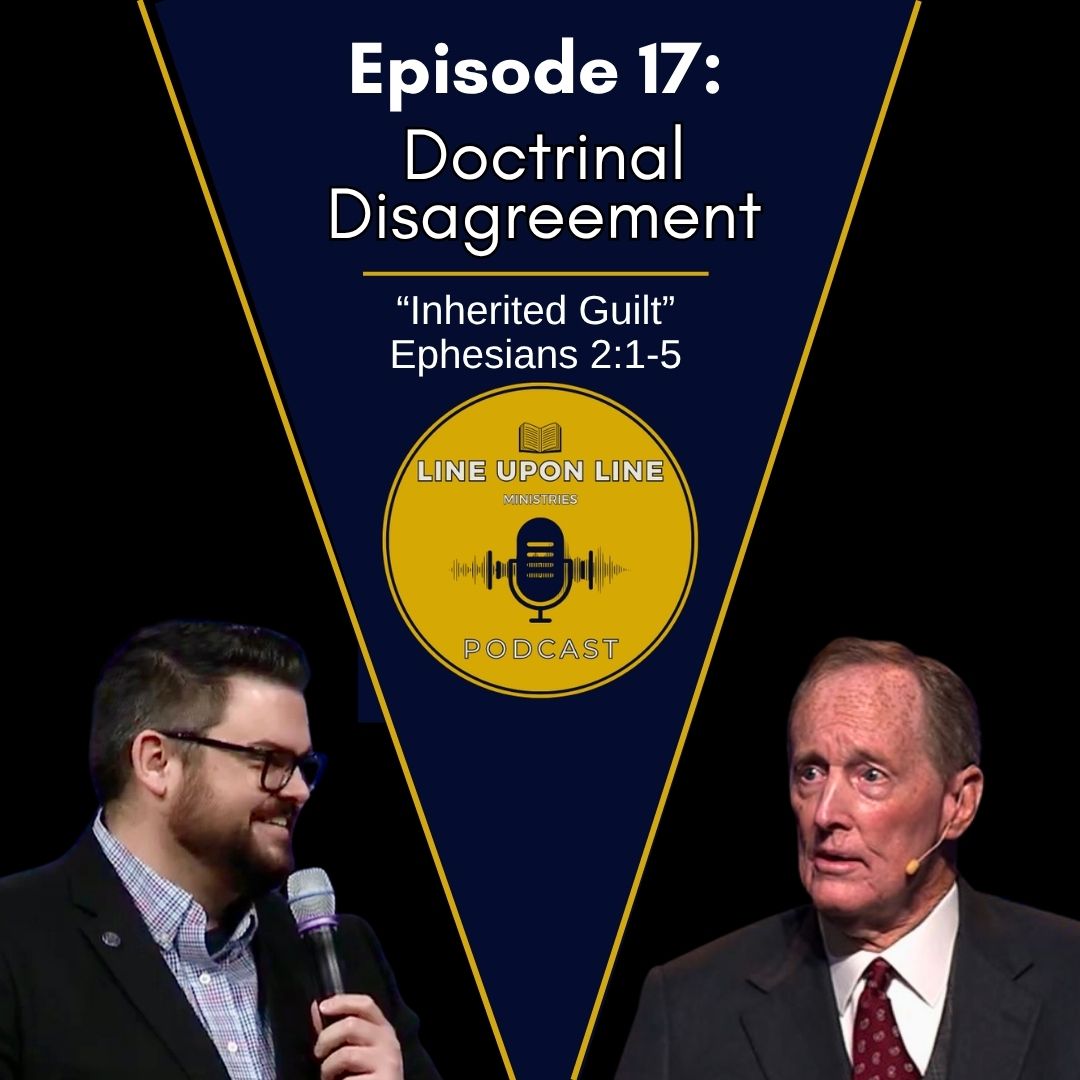
Hello and welcome to another episode of Line Upon Line Ministries podcast. I'm your host, Mark Williams at Line Upon Line. We are committed to the expository ministry of the Word for the life of the local church. Hey, you need to stick around until I make a huge announcement that we have for Line Upon Line Ministries. I'll. I'll announce it right before we share the David Miller sermon for this podcast. Very excited about that news. But today on the podcast we're going to do a couple things. We're going to talk about doctrinal disagreement.
I'm going to share this new, exciting announcement. And then we have today's classic sermon by Brother David Miller is on inherited guilt From Ephesians, chapter 2, verses 1 through 5. Before we do anything else, I want to say just a very quick thank you.
As you know, on the last podcast, I announced the release of my new booklet, Overcoming Anxiety, God's Way. And a lot of you have picked it up. You've sent messages, texts, reviews, emails. I got even a letter in the mail giving some encouragement about the booklet. The most encouraging messages are those who have been helped by it or were able to help a friend or family member work through some of their anxiety, God's Way. And so I just want to say thank you for the support. And if you have any questions about anything or if you would like, if you're interested in maybe picking up multiple copies for your church or your counseling center or just to have on hand, reach out to me directly and I'll try to get you a discount on some of those. But thank you so much for the support for this new booklet. I'm just, I'm without words for how awesome it is that the Lord has decided to use that. So thank you so much.
If you haven't checked out our website or Facebook or other social media lately, be sure to check those things out.
Links to all of those places are in the description or comments or wherever you're. Whatever you're watching or listening to right now, you can find the links to those places nearby. Whatever you're watching or listening to.
We try to keep those things updated with new resources.
Of course, the David Miller Sermon Archive is online.
We do different clips and things of those sermons on Facebook and YouTube and all those those places. So check those out, follow, like, do all those things.
And all those things help to spread the word of God and to help promote sound doctrine and teaching through line upon line.
So let's talk about doctrinal disagreement. Sounds like a fun topic, doesn't it? Let me say up front, I am not assuming that I'm going to fix all the doctrinal problems that Christianity has on this podcast in the next few minutes, but I do want to speak to the topic and hopefully give you some good thoughts and some advice about how to disagree.
Well, disagree Biblically, God's way so first of all, let me be clear. Doctrine matters.
Now, disagreement happens. Sometimes it's even necessary.
But disagreement on doctrine among brothers and sisters in Christ has got to be handled.
Well, it's got to be handled biblically in. In love, with humility, with desire to be sharpened by one another. Doctrine matters so much.
But doctrinal disagreement should not divide us as brothers and sisters in Christ.
There should be a unity of mind, a love, a single love for Christ, for His Word, for one another.
That must take precedence on any kind of doctrine disagreements.
So let's just talk about the fact that doctrine matters. First of all, doctrine, it just means the teaching of the Scriptures. For some of you who are watching, or pastors, you are very aware of what doctrine is. There may be others who, because of conversations around doctrine, may have a skewed view of what doctrine means. Doctrine is just the teaching of the Bible, various teachings of Scripture.
So doctrine is not optional.
It's not unimportant.
Christianity is built on doctrine. It's built on the revealed truth of God from His Word.
It's not built on just our feelings about who God is or the world is, or about who we are.
It is built on truth. And so that's why doctrine is so important. That's why doctrine is vital.
Doctrine tells us how we view God, how we view ourselves, how we view this world around us. It affects how we worship, how we preach, how we shepherd as pastors, how we live this Christian life. So we need to reject the idea that doctrine is unimportant, that it's not relevant, that it's just one of those things for biblical scholars to do. Doctrine matters daily for every Christian. So there's two extremes that people tend to go to. One extreme is just completely minimizing doctrine altogether.
I've heard phrases like, let's not worry about theology, let's just love Jesus.
If you've seen the meme with the Thor, basically you ask the question, okay, if. If that's your attitude, who is Jesus? Which Jesus?
What did this Jesus do?
I mean, those are doctrinal questions. How you answer that is doctrinal.
If you answer the question, you know which Jesus, and you say, well, the second person of the Trinity, the Son of God, who was fully God, fully man. You're doing doctrine, you're doing theology.
That is doctrinal conversation. That is a doctrinal understanding. So we can't minimize doctrine on one extreme. The other extreme is people who take certain pet doctrines and disagree about every single thing, regardless of what kind of doctrine it is.
They consider anyone who disagrees with them unfaithful to the Bible.
They make every issue something to fight about.
They take every secondary matter or every tertiary matter, and they make it a hill to die on.
If you don't believe like this, you're not a Christian, you're not faithful.
So those are the two extremes. What we need is a balance, a biblical balance. We need to be able to have strong convictions about what the Bible teaches without being quarrelsome, as Scripture says, without fighting over it, without bickering about differences of opinion, or again, clarity about what the Scriptures actually teach. We need to be able to have these conversations. We need to love one another without compromising biblical sound, Biblical doctrine. One phrase you've probably heard if you've had these conversations before or if you're a pastor or you've been around church for a while is something called doctrinal triage, meaning not all doctrines carry the same weight or importance. That doesn't mean that not all doctrines are important. Don't get me wrong. But there are different levels of importance. Let me explain this for those who. This sounds kind of weird too.
First of all, you have sort of core primary doctrines. These are.
These are the doctrines, the things of Scripture that are absolutely necessary. They're essential to having biblical Christianity.
They are a question of faithfulness as a Christian or not.
So some of those examples would be the Trinity, a belief that God by his nature is Father, Son and Holy Spirit.
To believe in the authority of Scripture, that. That the Scripture is God's word.
To believe in Christ, like we were just talking about a minute ago, as fully God and fully man.
The substitutionary atonement of Jesus Christ, his death on the cross and resurrection for sinners, the resurrection, the bodily resurrection of Jesus and also the resurrection from the dead. For all of us who are sa the salvation is by grace through faith in Christ alone. That is essential to the Christian faith and the fact that you must be born again.
There must be a new birth to go from death, spiritual death, to spiritual life. These are the kinds of core, primary doctrines that. That must be believed to disbelieve or believe something different about Jesus, that he's not fully God or that he's not fully man is to have a different Jesus than the Bible. So that's why these are called core, that you can't compromise on these particular doctrines.
And so those are. Those carry the most weight.
But there are secondary doctrines. Now, these are still serious, still important. So don't.
Just because I'm putting them at different levels doesn't mean that they're unimportant automatically. They're still very important.
These are things that would affect whether you have a membership at a local church.
It affects the kind of church order you have.
This is what kind of separates different denominations.
It has a tendency to separate whether or not we will cooperate with other groups on certain things.
Not that people who believe these things are automatically unfaithful or not Christians, these are not.
Beliefs that would make somebody a believer or not a believer. These are secondary.
So these are the kinds of doctrines that faithful Christians disagree on, even though we still recognize one another as brothers.
Classic examples of this, the mode of baptism immersion or sprinkling, whether a church is led by a plurality of elders or a single elder pastor model, those kinds of things.
A classic example of this for how we've seen this in, in evangelicalism and Christianity at large among different pastors is, you know, John MacArthur and R.C. sproul.
They have different beliefs on some of those secondary doctrine, and yet they had a good friendship and a united spirit when it comes to the primary doctrines.
We can disagree and yet still be united on these things.
Which also includes the third level of tertiary doctrines.
These doctrines also important.
None of the doctrines are unimportant.
Let me state that as clearly as I can. None of these doctrines, none of the doctrines of Scripture are unimportant.
These levels are just on whether or not you have to hold them in order to be a Christian or not, or to be a member of a local church or to be faithful in following your own conscience as the Holy Spirit guides you through His Word. That's where the tertiary doctrines come in. These are important, but they're.
They're not really matters of separation within each local congregation that might be separated by secondary doctrines from other denominations or local churches. You may have, even within that local congregation, differences of opinion, of conviction on certain things.
So these are things like if you have alcohol, some would say that would be more important than others. But this is one of those tertiary doctrines is you can be in the same church while one member may hold to a teetotaling view and another one that you know doesn't consider it a non.
Something you're not allowed to do whatsoever, but done in moderation or, or what have you. Now, I'm not stating my opinion on these necessarily. I'm saying those are differences of opinion, differences of conviction that you can hold differently and still rejoice and serve and love one another in the local church.
So some doctrines are essential to the Christian faith. Others are essential for the health of a local body, local churches in order to be organized in fellowship together.
And then others are important but should not be points of contention should not divide us within our local churches.
So a personal example of this is my relationship with Brother David Miller.
When I first got here and became pastor of Tumbling Shoals Baptist Church, Brother David Miller sort of took me in and befriended me and loved me and cared for me and I spent a lot of time in his home.
And during those times we would have conversations about the Bible, about doctrine, about practice and different kinds of things, as you know, if you know David Miller at all and, or for any length of time. Brother David was a man of doctrinal conviction. He had his convictions that he believed and he, he preached them. He taught the Scriptures, he, he taught doctrine, he preached the truth. He did not treat doctrine as unimportant by any means or it didn't skip over anything whatsoever. But David and I did not agree on every single thing.
We agreed on the essentials 100%.
There were some wonderful times of just reflecting on the sufficiency of God's word, on the substitutionary atonement of Christ, on the beauty of the church and God's people and salvation and, and all these wonderful things. Expository preaching, just the doctrines of grace, all of these. We had wonderful conversations in agreement with, with some of these essentials.
But there were some secondary and tertiary matters that we disagreed on.
I won't get into all of those because that's not important.
The reason why I even bring this up is because we need to learn how to be able to disagree biblically.
Well, these disagreements that I had with even Brother David Miller was helpful. It was healthy. It was biblical.
We talked through some of these issues that we disagreed on. We opened the Scriptures together. We, we looked at the text. We. He challenged me on, on, on certain things that I've held on to and, and had to relook at.
But I pressed on him on some things and both of us, I believe, were helped and convinced by the others, especially where we were pointed to the Scriptures again That's the, that's the standard. Not our own convictions or our own beliefs, but what does the Bible actually say? And let's help one another to get there.
And so he convinced me on some things. I, I believe I convinced him on some things. Well, he, he shared up at least one thing with me that, that he said, I'm starting to, to turn him on.
But both of us were better for it.
Our disagreements didn't cause us to be at war with one another or that was harmful or cause us to not be friends anymore. If anything, it strengthened that.
I loved my time with brother David. And those conversations were so helpful to me, and I believe they were helpful for him as well. What we were doing there essentially is what the Scriptures call iron on iron sharpening. We were, we were sharpening one another. Proverbs 27:17. Iron sharpens iron. So man sharpens the countenance of his friend.
And that, and that's what disagreeing on doctrine can and should do among brothers in Christ. When we have healthy doctrinal disagreements, it should sharpen one another. It should not make us hate one another or harden us against one another.
Doctrinal disagreements is one of the things that the Lord uses to sharpen us as his people, that he uses in our life to make us understand better and to love one another better and to love him more and to understand, understand these things better.
So the call to us today in the world and the culture that we live in, with social media, and the arguing that takes place there, or the bickering or the fighting, the disagreements that are unhealthy, we need to understand what God does tell us about how to disagree.
A healthy doctrinal disagreement requires, first and foremost, humility.
Pride must be squashed.
We must see our brother as more important than ourselves. As Philippians 2 tells us, before we ever even discuss our convictions or doctrine or theology, we must have a spirit of humility.
So we need to have the right spirit.
Of course, we need the Holy Spirit. So you're not going to have a good doctrinal disagreement with someone who's not truly a believer. There is that, but humility should be the spirit that you come to a disagreement with.
A disagreement, a doctrinal disagreement with a brother should not just include humility, but you should come to that disagreement. You should come to that conversation with an open Bible.
Coming to a doctrinal disagreement with your Bibles, closed is a quick way to an argument.
So we need humility. We need open Bibles. We need to be patient with One another. We need to carefully learn to listen to one another, not just listen for how we respond or hear. While we're ready to already say what we want to say, we need to come ready to listen, and we need to come willing to learn and be corrected.
Guess what? As much as you believe you're right, you're not Jesus, I'm not Jesus.
There are we in our beliefs, in our understanding of Scripture. There is always more for us to understand, to be sharpened in.
So it can only be good if we come to one another with open Bibles and help one another to see what Scripture says.
We need to come in this kind of spirit, loving one another, submitting to one another in love, as Scripture says, seeking the truth, not just trying to win an argument.
Remove pride, unnecessary sarcasm. Sometimes sarcasm is useful, but not in arguments like this, not in doctrinal disagreement.
We need to. We need to focus our attention not on winning an argument, but on loving and helping to sharpen our brother and willing to be sharpened ourself.
Ultimately, there is a way to contend for the faith without being contentious.
You can argue your conscience without being argumentative.
We need to come with the spirit of gentleness.
Ultimately, we need to have the balance that Ephesians 4 reminds us of, that we need to have both truth and love. We need to speak the truth in love.
If you. If you speak truth without love, 1 Corinthians 13 explains what that is like.
If you come to speak with love, but there's no truth, that's empty, it's worthless. It's truth in love. Both must be there. Love cannot become an excuse for being doctrinally careless to care less about what doctrine is and what the Scriptures actually say.
We can't do that. But at the same time, having the right doctrine can't be an excuse for failing to love our brother in this disagreement. Doctrinal disagreements can be a wonderful tool that the Lord uses in our lives. If we have the right spirit, we come with the right attitude. Open Bibles to come, humbly, not wanting to win an argument, but seeking the truth and seeking to speak the truth in love.
Now, this leads me to the exciting announcement for this podcast.
We are excited to announce the release of the very first book of David Miller's sermons. It is called the Doctrines of Grace. It is five sermons from brother David Miller and it is so new. It's out now. You can click on the links and do all those kinds of things. It's out now, but it's so new that when I was recording this I don't even have a copy yet. This is the proof copy with a big gray line down the middle. But this, this is, this is out now. It's available now on Amazon. You can go there. You click the links in the description or wherever we'll be posting it on social media, all that kind of stuff. If you're listening to this podcast or you're watching this podcast, it is available online right now at Amazon. You can go there. The Doctrines of Grace 5 Sermons by David Miller.
You can find that, pick up a copy either a paperback. There's also it's available on Kindle.
Buy one, Buy one for your friends. Buy one for your pastor. Buy one for your church member friends.
This is Brother David at At His Best Again, Brother David Strong Doctrinal Convictions. I have enjoyed reading through the proof. I helped edit it. I did edit it, but even reading through the proof, I could hear Brother David's voice.
It's a joy to read through these sermons, so be sure to pick one up if you can. Leave us a review on Amazon. Share one with your friends.
If you are on our newsletter, you see in that email we have a section there that you can copy and paste and then share it on your social media or text it to people, email it to people, help spread the word about this new book. We're very excited to share it and hope and pray that God will use it to open people's eyes to his glorious grace.
And so now let's move to the classic sermon by Brother David Miller, which is actually one of the sermons in the new book on inherited guilt from Ephesians, chapter 2, verses 1 through 5. Enjoy.
[00:27:38] Speaker B: Would you turn please to the book of Ephesians, chapter two, Ephesians, Chapter two.
I want to address this question.
What does man receive from his Father Adam, That anything you might be interested in.
Let's begin at verse one.
And you hath he quickened, who were dead in trespasses and sins, wherein in time past ye walked according to the course of this world, according to the prince of the power of the air, the Spirit that now worketh in the children of disobedience, among whom also we all had our conversation in time past, in the lust of our flesh, fulfilling the desires of the flesh and of the mind, and were by nature the children of wrath.
But God, who is rich in mercy for his great love, wherewith he loved us even when we were dead in sin, sins hath quickened us together with Christ by grace ye are saved.
I seldom give lengthy introductory remarks in my Sermons, I usually don't have time.
I want to get right to the text.
But this morning I want to take a couple of minutes and tell you that there's a great discussion going on in Southern Baptist life regarding the doctrines of grace.
And many good brethren have decided that they don't agree with me.
They don't cross every T nor dot every I like I do.
Now, I know you find that to be unusual.
The discussion is both healthy and helpful.
There are those among us who do not believe that you and I inherit guilt because of Adam's transgression.
This is an error on their part.
Baptist history is on our side.
I'm going to get to the Bible being on our side in a moment, Telling you that the Baptists in America, from which we descended, believed that we not only receive a nature that is inclined to evil and we are born into a world that is inclined to evil, but we did in fact receive from Adam, by way of imputation, the guilt of his sin.
That's what our kind of Baptists have believed.
The 1869 London Confession, the historic Philadelphia Confession, the New Hampshire Confession, the Charleston Confession, the Sandy Creek Brethren.
Southwestern Baptist Theological Seminary was established prior to 1925, the New Orleans Baptist Theological Seminary established prior to 1925, and the Southern Baptist Theological Seminary in Louisville was established prior to the Baptist Faith and Message Confession of Southern Baptist in 1925.
All of these confessions lead us to conclude that man received from his father Adam not only a nature inclined to evil, but the guilt of Adam's transgression.
We are guilty before God on two counts.
We are guilty in Adam, and we are guilty by our personal choice, not one or the other.
We're guilty on both counts.
This is human depravity.
We are crooked, we are iniquitous.
And it has infected the very essence of who we are.
It is the sum and substance, the wool and wart of our being.
In verses 1 through 3 of our passage, the apostle gives us a 5 explanation about depravity.
Number one. He says that you received by nature, by natural generation from Adam spiritual death, and you cannot activate yourself.
Listen to it, you Ephesian saints.
You hath God quickened, who were dead in trespasses and sins.
To be dead in trespasses and sins to be alienated, separated and estranged from God.
Dead spiritually and with your best efforts.
You cannot activate yourself.
You cannot be stirring yourself. You cannot pick yourself up by your bootstraps and function in the spiritual realm.
Dead spiritually.
Some have sought to get around this Biblical truth. With illustrations like this, you can cut a snake's head off and yet he might still bite you.
Have you heard that one?
It was given at the John 3:16 cuff conference just a few years ago.
But are you aware you can cut a snake's head off at the tail?
You ever thought about that?
It depends on how far back you cut a snake's head off, whether he can ever bite you again.
And so the illustration breaks down.
Others have said the unregenerate man is like the fellow who is out in the water and he cannot swim.
And so he's struggling, he's frailing about, he's gone down once and twice and you throw out the lifeline, you throw out the lifeline to him, but it is he who reaches forth and takes hold of it.
But the illustration breaks down at this point.
You weren't out on life sea struggling.
You had not gone down once nor twice.
You were drowned already.
And the miracle of regeneration is that God enables you, quickens you, makes you alive, grants you a spirit of repentance and faith and ability to reach out now and take hold of the lifeline.
What about that?
The miracle is not that you took hold of the lifeline.
The miracle in conversion is that God enabled you when you were dead in sins.
Now, an expositor of scripture does not have to be in a hurry.
We have to be in a hurry because of the schedule when we're invited to preach on the program, and that's vitally important.
But when you learn to expound the Scriptures verse by verse, line by line, you can take a little time and talk about regeneration. Here you can quote the Baptist faith and message.
Regeneration is a change of heart wrought by the Holy Spirit through conviction of sin, to which the sinner responds.
Now, I might suggest to you that you can't respond to something you don't have.
This quickening, this change of heart, has already taken place. Now you respond with repentance toward God and faith in the Lord Jesus Christ.
Charles Spurgeon said it like this.
Regeneration is a change of heart wrought by the Holy Ghost.
A mighty grace which the sinner does not wish to resist, enters into the man, makes a new creature of him, and he is saved.
We sang about it this very morning.
Long my imprisoned spirit lay fast, bounding sin and nature's night.
Thine eye diffused a quickening ray.
I woke, the dungeon flamed with light, my chains fell off, my heart was free.
I rose, went forth and followed thee.
That's regeneration.
Now, prior to regeneration, you're Dead spiritually.
It is obvious that I don't have as much physical vitality and strength as you do. This is not an act.
This is not a gimmick to improve the love offerings.
It's not.
But guess what? Old David ain't dead yet.
There are some vital signs and I don't want some jake legged preacher to say the benediction at my graveside until I've gone the last mile of the way.
I don't want it to be said of me, his son set while yet was day.
I'm alive and I'm enjoying life.
And I want to tell you there was a time when I was dead spiritually and there weren't any vital signs.
I mean, you could have developed some kind of spiritual X ray machine and you couldn't have found any evidence of spiritual life in me.
I was flatline.
But I've got a different song today.
I've been changed I've been newborn My life has been rearranged what a difference it made when Jesus came and stayed in my heart oh yes, I've been changed.
Are y' all getting any of this yet?
Now here's the second item you received by nature, moral defilement.
And you cannot rehabilitate yourself.
He says in verse 2.
Wherein in time past you walked according to the course of this world, that is as a pattern of life, you followed the spirit of the age.
And the spirit in every age is in diametric opposition to God's standards of morality and righteousness.
Now that does not mean that there's never any moral restraint.
I'm glad I grew up in a home, in a community, a church, in a school that exercised some moral restraint upon my activities.
My mama was only 5ft 2 inches. She was about as broad, as tall.
And if she had known that I even thought some of the stuff that I thought, she would have frailed the daylights out of me.
Now when a child grows up in that kind of environment, it does in fact have some moral restraint.
Brother Arnold Knight, the pastor at the Good Hope Missionary Baptist Church, would come by our place.
My mama was a single parent and he would never come inside alone.
He would visit out on the front porch and before he left he'd get around to asking a question like this.
Ms. Bertha, is David behaving himself?
Brother? That'll sober you up.
And I honestly believed. I believed that if my mom had even knotted her head negatively that he would have taken his belt off right then and right there.
That'll have some restraint on your morality.
My high school Football coach would not allow you to play on the team if you smoked a cigarette or if you even happened to be in the vicinity where a beer can was.
I'm glad I grew up in a time like that.
I tell you, I feel a lot of compassion for the young generation of our day.
I tell you it's harder in our day than it's ever been before.
Defiled morally, cannot rehabilitate yourself.
Number three. He says that you are dominated satanically and cannot liberate yourself.
Not only did we walk according to the course of this world, we walked according to the prince of the power of the air, the spirit that now worketh in the children of disobedience.
Before regeneration, you and I were under the awful influence of the devil. He exercised control, had sway in our thinking and in our actions.
And with our best efforts, we could never liberate ourselves from him. Do you remember those days in your own experience?
Did you ever try to make a deal with the Lord before your conversion? Did you ever say something like this when, lord, if you'll just bless me, if you will just do this for me, I promise that I will straighten up and do right.
I did that.
I was 10 years old.
I was over at Ben Clark's pond.
I saw a swirl near the bank. I went over, stood still.
In a moment, two of the biggest bass I'd ever seen in my life came right there under me.
I fished and I fished, but I couldn't get them to bite. But I was so excited about it. When I got home, I convinced my mom that if she would allow me to get off of the bus out at Doyle Mark's store the next afternoon and buy one of those plastic fishing worms with three exposed hooks that I could catch the biggest bass in the county.
And I got off the bus, purchased the worm, ran back home, got my cane fishing pole with a 20 pound test line, and I headed across the pasture to Ben Clark's pond.
When I got to within about a hundred yards, I got really spiritual about it.
And I started praying and I said, lord, if you will allow me to catch one of those bass today, I promise you that I'll never cuss again as long as I live.
I eased up to the bank, waited quietly. After a moment or two, one of those bass came up close.
I flipped the worm out, drug it by him, but he didn't bite. I nearly wore the hooks off that worm, Throwing it out there and dragging it back. Even touched him, ran it right under his nose and he wouldn't bite in A moment I decided to change my strategy. I decided if I got the worm lined up just right and I'd get it right up close to him when the opposite side, if I just gave a mighty jerk, I might snag the bass.
And in a moment I had it lined up precisely where it needed to be. And when I gave the jerk, two of the hooks caught him under the gills and I brought him right out on the bank behind me.
I went back there and fell on him.
I took the hooks out and I ran over the door mark store to get him weighed.
And he weighed three pounds.
Well, that might not seem like much to you anglers, but it's the biggest bass I'd ever seen before I caught him.
I wonder though, if there are any of you in this room who are so naive that you think I never cussed again.
But I tried.
But it wasn't very long. Just a few days.
We were up at Copeland Hills barn a Sunday afternoon. Bill Hill and Sherwin and Grant Kelly and David Clark, Fulton Lofton and myself. And we had had a corn cob war.
It's amazing how country kids can entertain themselves.
Those of us who were more astute at the game would gather up the corn cobs, break them in half, put the bigger end in a rain barrel and they'd soak up that water and they'd be heavier and you could fling them with more velocity and accuracy. And when your opponent stuck his head from around the corner or from a bale of hay, you'd let him have it.
We'd had one of these notorious wars and we were sitting in the loft making our boast and nursing our wounds. And those boys began to use some bad language.
And before I realized it, I had joined in.
But immediately my heart was smitten and I felt terribly bad.
And when I got along later, I said, lord, I'm sorry. I promised and I failed.
But it wasn't long till I'd sinned again.
Now you may be thinking now, brother David, we've heard you preach a bunch of times. We've never heard such a illustration.
But listen, it doesn't matter if you're a 10 year old red headed, freckle faced country kid trying to quit cussing or whether you're 40 years old with a wife and three children.
And on Friday afternoon when you get paid, you know that you ought to go home and pay the bills and take your wife out and, and buy the groceries. But you've got to pass by the tavern and you say, now I'm not going to stop in there today.
This is not good.
But when the tavern comes into view, it seems there's a compelling compulsion, a strong inclination, a mighty bent that you cannot resist. And you turn in there telling yourself, I'll only have a couple of drinks, say hello to the boys, and I'm going home.
But midnight finds you there in a drunken stupor. And at one o' clock in the morning, you stagger in home to break your wife's heart and to frighten your children to death. And it goes on week after week, month after month.
You're dominated satanically.
We live in an unfriendly environment.
And I tell you, the devil knows our vulnerabilities, he knows our weaknesses, and he is able to come against us right at the precise moment of our weakness.
Are y' all getting this?
Number four.
We are debilitated volitionally and cannot elevate ourselves.
Listen to it. Verse 3.
Among whom also we all had our manner of life in time past, fulfilling the desires of the flesh and of the mind.
This statement and of the mind refers to those higher faculties of the soul, the intellect and the will.
And here he says, before our conversion, we were debilitated to the point that we were constantly fulfilling the desires of our flesh and our minds.
Now, you and I possess a will, and we are responsible for the use of that will.
We just ought not put too much confidence in our volitional capabilities.
Now, let me remind you that there's a difference in the will that you and I possess and the will that Adam possessed.
You see, Adam had free will.
You and I do not.
Let me explain further.
You see, God created Adam in innocence.
Adam had sufficiency within himself volitionally to stand in obedience to God.
And yet he was free to fall.
Do you see it?
That's Adam's volition prior to the fall. Sufficient to stand, but free to fall. That's free will.
But, beloved, you and I never possess that kind of will.
We were never sufficient within ourselves, within our volitional capacity to make the choices that were good and right and wholesome in the sight of God.
We never had that capacity. And furthermore, we didn't have the choice regarding the fall that was imputed to us.
Why are some of you looking at me like that?
You ought to see the seriousness on your countenance at this point.
You've got a will and you're responsible for the use of it. But don't place too much confidence in it.
Let me illustrate it.
Over in Arkansas, where I live, we have Vultures, but we call them buzzards.
And a vulture eats carrion.
Rotten flesh.
It's what he desires. It's his nature.
They tell us you can take a vulture out to Kansas, set him down in the middle of a wheat field where there are tons of grain. The pheasant and the quail thrive there.
You don't coerce him.
You don't force him.
You leave him there to do his own thing. You leave him there bound to his own nature.
And he will starve to death and his bones will bleach white right out there in the middle of a wheat field.
And I'm telling you, that's the problem with the human will.
Prior to regeneration, we are in this world that is full of rottenness and decay.
And that's what our nature craves.
That's what our flesh wants.
And we had no ability to raise ourselves up out of that debilitation volitionally.
Now, here's the fifth Adam.
And were by nature the children of wrath.
We were damned eternally and could not exonerate ourselves.
Now, I want you to straighten up a little bit.
Some of you are a little more comfortable than you ought to be in church.
Get your shoulders back and your chin up.
Because I am about to ask you a very personal question.
Are you ready?
Am I addressing a heterosexual congregation this morning?
Don't answer that.
Don't answer that.
Assuming that I am addressing a heterosexual crowd, the next question is, when did you become a heterosexual?
Was it prior to or subsequent to your marriage and your honeymoon?
I told you it was going to be personal.
And, beloved, listen to me.
As surely as you were a heterosexual prior to your marriage, you by nature were a child of wrath under the condemnation of God Almighty.
Did y' all get that?
Did that make a bit of sense?
Will, ponder it.
Now, do like this.
I want you to put that aside now.
And I want to give you the second half of the sermon.
I've talked to you about the depravity and sin now, our dependence on the Savior.
But God, who is rich in mercy for his great love, wherewith he loved us even when we were dead in sins, hath quickened us together with Christ.
By grace ye are saved.
If I had the time to expound these verses, if I had the time, I would say three things.
In fact, if I had the time, here's what I would say.
I would say something about who loved us.
I would say something about when he loved us.
And I'd say something about what he did because loved us. But I don't have the time.
So I'll just say something about when he loved us.
Even when we were dead, he loved us and quickened us.
Now I've learned something about myself.
I've learned that it's easier for me to love folks who love me. Me, I can get along with folks who are affable, kind, gracious, complimentary.
Somebody come by and slap me on the back and say, oh, Brother David, that was great preaching.
I can just kind of say to myself, that old boy has got discernment.
Somebody comes by and says, preacher, where did you get that tie that didn't come from Uncle Dudley's bargain basement.
I can kind of think to myself, here is a man who has good taste in menswear.
I love people that love me, don't you?
But there are some folks who don't love me.
I've wondered about that.
Why in this world would anybody not love me?
Now I'm going to repeat something I heard a man say. I do not subscribe to this.
I'm only giving this by way of information. Information.
But I heard a man say that all women are perfect angels for three reasons.
Number one, they are always up in the air.
And number two, they never have an earthly thing to wear.
And number three, they're always harping.
I don't believe a word of that, and I'd never in this world say that.
I do know, however, that if you let one of these old sisters come by me at just the right time, all up in the air, harping, maybe I've already got a bad case of out of sorts.
Maybe the Razorbacks lost to Alabama because the referee C. And I dog died.
And I'm bent out of shape.
And here she comes all up in the air, harping, wanting to read me the riot act.
She's not careful, she's liable to bite off more than she can chew.
I'm liable to tell her a thing or two.
And I can tell by looking at you, you're just like me.
Aren't you glad you're not having to depend on me to love you?
And I'm glad I'm not having to depend on you to love me.
But I want to tell you something far greater.
Aren't we all glad that God is not like either one of us?
Aren't we glad that God didn't wait till we who were dead in sins had somehow or other bestirred ourselves spiritually?
Aren't you glad that God didn't wait till we who were defile morally had somehow or other gotten our act together.
Aren't you glad God didn't wait till you dominated satanically somehow or other had broken the bond?
Aren't you glad that God didn't wait till we who were debilitated volitionally and on our best day in our finest academic moments, could not elevate ourselves to the point of thinking spiritual thoughts and we who were condemned, unable to exonerate ourselves before holy justice?
Aren't you glad God didn't wait?
Herein is the love of God. God manifested that while we were yet sinners, God quickened us by grace ye are saved.
Let's pray together.
Our Father, these things are weighty.
They cause us to be sober, they cause us to be serious, and yet, Father, they are delightful and glorious in that you have quickened us with Christ.
We exult in the grace of God in Christ Jesus.
Write these truths indelibly upon our hearts and before our eyes for Jesus sake.
Amen.
[01:09:59] Speaker A: I hope you've enjoyed this episode of the Line Upon Line Ministries podcast. Be sure again to check out the links below in the description or above in the post. Wherever you might be listening or watching this podcast and find the new book, go to our social media, do all those kinds of things.
Check out the website. If you have any questions about anything, feel free to reach out to me lineuponlineministriesmail.com I'd love to answer any questions you may have. If you have other videos or pictures or stories of Brother David that you would like us to have, we would enjoy having those. We can put those on the the archive or on the website to keep all of those things together. If you're interested in joining our newsletter, I'll leave a link to sign up for that as well. Or you can also find that on our website to stay in touch about future upcoming resources and other ideas we have in store. This is the first book, but it's not going to be the only book. We're excited to start sharing more of Brother David's sermons in print and hope that it is a blessing as well. Thanks again for joining us on this episode of the Line Upon Line Ministries podcast. God bless you as you continue to study and minister God's Word. Line upon Line.