Episode Transcript
[00:00:00] Speaker A: Foreign.
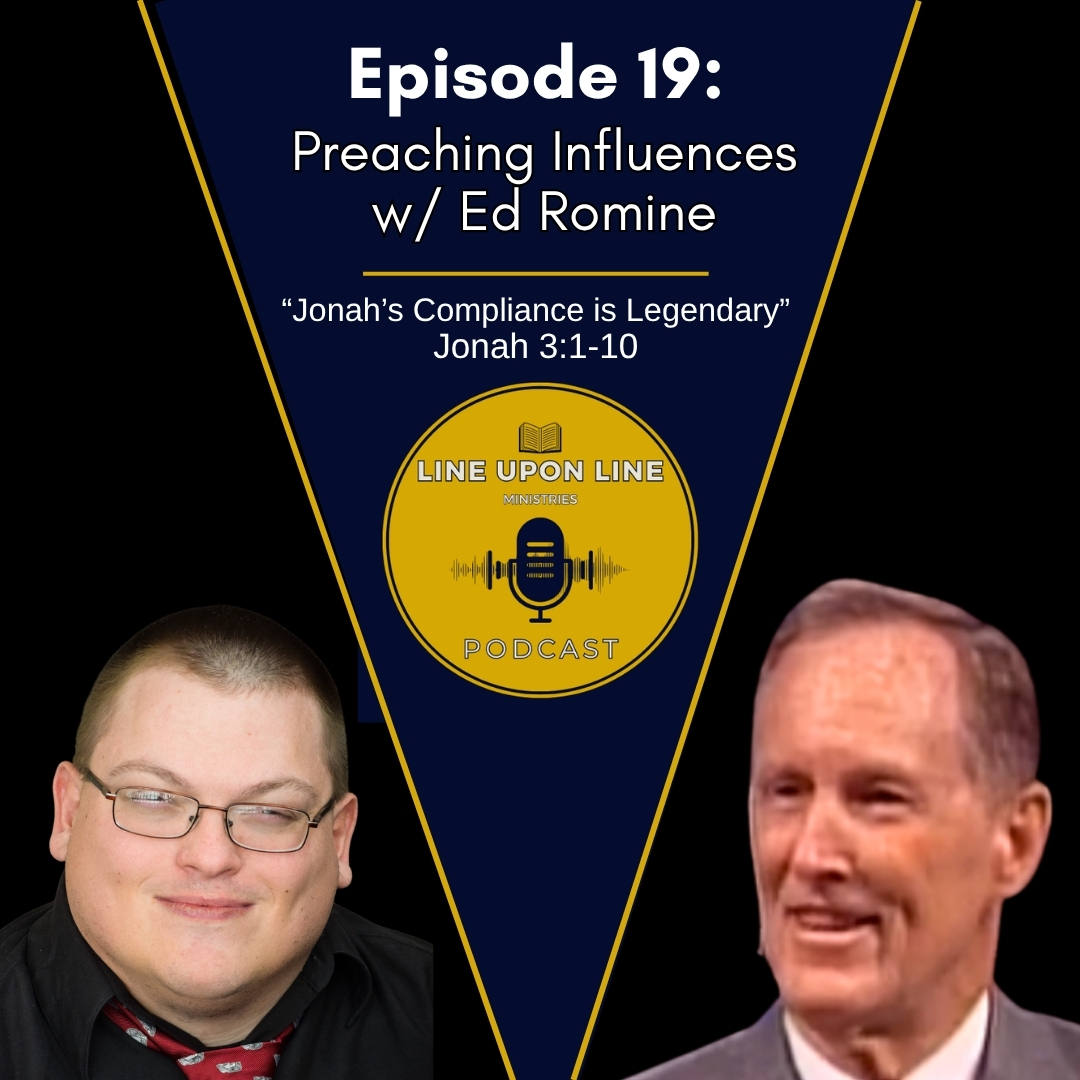
[00:00:10] Speaker B: Welcome to another episode of the Line Upon Line Ministries podcast. My name is Mark Williams. Line Upon Line. We are committed to the expository ministry of the Word for the life of the local church. Coming up on this episode, we have the second part of our interview with Brother Ed Romine, along with another classic sermon by Brother David Miller from Jonah Chapter three. Before we jump into the main content of the podcast today, I want to encourage you to check out our website www. Lineuponlineministries.com for new sermons, updated, new resources added to the store, things like that.
Also want to mention thank you once again for those who have supported the doctrines of Grace Book. It's been overwhelming to see the response and so we just want to say thank you again and once again if you've had the opportunity to read it and you would like to leave a review on Amazon, that goes a long way to spread the word.
Also, as I mentioned last time on the podcast, my new booklet Handling Conflict God's Way has also been released and so you can go to Amazon and pick that up. I also would appreciate reviews on that booklet as well. You can find the links to both of these books in the description below or wherever you're watching this podcast. One other resource that I want to recommend to you is Brother Ed Romine's book.
He wrote his dissertation on Charles Spurgeon, as I mentioned last podcast, and his open air preaching, but he turned that dissertation into a book called the Booming Baritone Bell of England.
Wonderful title on the pedagogy and practice of Charles Spurgeon's open air preaching. I'll have a link to that in the description as well.
You would. It'd be wonderful if you picked that up. Brother Ed is a is a wonderful Brother in Christ preacher writer and I know you'll be encouraged by that if that's a topic that is interesting to you.
Periodically throughout these podcasts I request from you help to find content from Brother David Miller through over the over the weeks, over the months, there's been people that have reached out and said hey, we have this video picture. Hey, did you know that Brother David wrote a chapter in this book that we had published and things like that. Those are all very helpful. We want to try to capture as much of that content and make it available or at least point people to content through the online archive on our website. So if you have any more of that, Please contact me. LineupOnlineMinistries Gmail.com is the email address. Love to hear from you about anything you might have from Brother David.
And now let's go to the second part of the interview once again. Brother Brother Ed has his PhD from Midwestern Baptist Theological Seminary. He is currently on staff as a pastor in First Baptist Church of Provo, Utah. Does a lot of open air preaching on the part of the interview today. We'll talk more about that, his work with Spurgeon, some of the influence of Brother David on his preaching. And so I know you will enjoy the rest of this interview with Brother Ed.
And I'm glad to hear, glad to hear that the, the Lord used Brother David in your life in such a, such a wonderful and encouraging way, especially in some of those more difficult times.
To have somebody like that, that can, that can know exactly, you know, what you're going through and let you know, man, what you're facing right now, this moment of getting depressed and getting down on yourself. You know, I've been there. That, man, that, that speaks volumes, I'm sure.
Obviously I'm not in your, your situation. So that means a whole lot more the more to you than, than it, it would necessarily to me just because of that connection that you had there.
[00:04:25] Speaker A: Right. Right.
And, and I'll tell you, Justin Peters, at the risk of embarrassing county, is another brother that I, I feel very much the same about. I, I, I love, I, I cherish him. You know, if I'm having disability specific problems, he, he's, yeah. Another brother in my life that I go to.
Hey, I'm, I'm struggling right now, even if it's something as true, you know, getting anxiety because I've got to go through TSA again, you know.
[00:05:08] Speaker B: Yeah. Because I can imagine that's, that's a much more difficult process for you.
[00:05:13] Speaker A: Yes, yes. And it seems unnecessarily so with the risk of complaining, but I don't want to go down that route necessarily.
[00:05:24] Speaker B: No, no, no, I got you. I understand. Well, it's wonderful to have those kind of men in your life that you can, that you can identify with and, and, and our Calvinist that can help you point you to the, the sovereign God who's actually in control. You know, that's the thing too.
[00:05:43] Speaker A: I'm glad you brought that up. Because God is incapable of ever seeing hoops.
He.
[00:05:59] Speaker B: That's right.
[00:05:59] Speaker A: He never makes mistakes and.
[00:06:03] Speaker B: That's right.
[00:06:04] Speaker A: And even in passages where it seems like God changes his mind, like, like in Jonah or Genesis though that language, it is for our benefit and doesn't actually show a change within the mind or eternal decree of God and to Know that God is in absolute, complete control and nothing takes him by surprise.
I'll never understand personally while why there are those out there who despise the doctrines of God's sovereignty, not only in salvation, but also in his eternal decree. Like the plan of God is perfect.
Whether somebody drowned in the worldwide flood or whether they live the life of as God glorifying as David Miller, nobody will ever be able to say, God, you did wrong in your decree.
And so, yeah, now I'm preaching at you, so I'll shut up.
[00:07:30] Speaker B: No, I like it, I like it. This is good. This is good. And this is, this is what our soul needs, needs to be reminded of daily, even, you know, because we can, we can very, very easily, very quickly get into the mindset that, oh, what was me or this, this thing that's happening today is, is out of hand or, you know, this, that and the other. But when we recognize that God is sovereign and he is working out his. His plan gives us a sense of, of hope and peace, security.
Just in the midst of, of like we were talking about the, all the effects of the fall, the stuff we have to go through. So now that's a good word, brother. I appreciate that. It's a good reminder for us, man. I appreciate you sharing some about, about David. If you got a little time, I'd love to talk to you a little bit more about, you know, preaching and maybe Spurgeon. Yeah, I know you, you did your PhD.
Your, your PhD is historical theology, is that right?
[00:08:38] Speaker A: Well, technically, okay, I think. Well, back when I was there, everybody got a biblical studies PhD with certain emphases.
[00:08:46] Speaker B: Right.
[00:08:47] Speaker A: But so I don't tell people that in all honesty, because then they think I can teach Aramaic and I can't, you know.
Right, yeah.
[00:09:02] Speaker B: Oh, I, I get it, I get it.
[00:09:03] Speaker A: I just tell people it's an historical thing. That's. But yeah, yeah, yeah, but so you
[00:09:11] Speaker B: wrote, you wrote on Spurgeon though, right? What, what was your, what was your emphasis there? Was it on his preaching? Was it.
[00:09:16] Speaker A: What was specifically his open air preaching?
So I already mentioned it earlier in the podcast with bringing Brother David out to do it. It's something that, yeah, I got involved with back in 2014 through the influence of now pastor Taylor Callan, who is currently at the time of this podcast recording, pastoring Horicon Baptist Church in Brant Lake, New York.
A wonderful little congregation and just a wonderful pastor as well. Taylor is.
Back when he was an 18 year old young man, he invited me to go out with him to do evangelism. You know what I told him? I'm like, no, I don't want to do that, because then you'd have to push me around everywhere.
I wouldn't want you to do that. So add the tuna thinking, like, I'm going to be a burden.
And Taylor said, don't worry about that. I'll push you around wherever.
And so I said, okay. I thought, he's not going to do this. After the first time, I. I was bigger, more rotund in the building back then than I am now, so. But you know what? He.
He kept doing it. And the first time I opened their preach was at a Dallas Cowboys game.
[00:10:52] Speaker B: Really? Just right outside the front?
[00:10:54] Speaker A: Yep. And I had a drunk fan and buy too much beer, get in my face and yell. And that was quite something for first ever.
[00:11:07] Speaker B: That was your first time?
[00:11:08] Speaker A: Yeah. And wow. Yeah. But the games after that were much more docile. Didn't have many drunk people get up in my face. So that was a.
That was quite the first experience back and would have been September, maybe October 2013.
So. So we're talking about. I've been doing this for a little while now, and.
At some point during that time, I'd gotten introduced through the life and ministry of Spurgeon, through Stephen Lawson's little book, the Gospel Focus of Charles Haddon Spurgeon.
That book got me into spirit.
I read that book in just a couple, like three hours.
I couldn't put it down. I was fascinated by the man in this ministry. So after that little book, I got to read more stuff. I managed to also acquire a copy of his lectures to my students.
Then there's that read through that
[00:12:29] Speaker C: I
[00:12:29] Speaker A: came across in volume two of the lectures, because it's four volumes and one big book. And in volume two, okay.
He has two lectures devoted to open air preaching.
The first one is Open Air Preaching A Sketch of Its History.
Of its History. And what he does in that lecture to his students is he goes from the time of Noah all the way through to the present day 19th century for him, showing how open air preaching has always been a part of the Bible story and open air preaching has always been a part of the history of the church. Church. I found that fascinating. And then his second lecture is called Open Air Preaching Remarks their own.
And it sounds exactly like what it is is exactly like what it sounds.
He's just giving practical hints to his students on open air preaching.
Like such things as, like, don't yell your lungs out. You don't want people to think you're crazy.
Basically says that make sure you preach with the wind, not against the wind.
There's a little spurt in there where he says he hates preaching under tens. Like really. And he tells you how he really feels.
[00:14:06] Speaker B: Wow.
[00:14:08] Speaker A: You know, he'll.
He'll say such things as make sure that when you preach that you are actually showing love to the people.
Don't be an angry preacher.
And the Pelagians need to hear things like that as well as fix their doctrine by God's grace.
A lot of angry open air preachers, I don't think they're sin anymore currently.
[00:14:48] Speaker B: Yeah.
[00:14:48] Speaker A: And so I found out asking around people didn't realize Spurgeon had.
Did those lectures. A lot of people were not aware and I wasn't.
And I even found out at the time Tom Nettles was not that familiar with them.
And so I realized that there were. There was three sermons in the new Park street pulpit. The first six and a half volumes of the big 63 volume set.
There were three open air sermons that were given.
So my dissertation is looking at the context of Spurgeon's laughing and evangelical and 19th century and then showing how he was put in a time and space and history that was primed for evangelism.
And then showing through analyzing those two lectures and looking at the three open air sermons that open air preaching is the driving impetus for what made Spurgeon so good in the pulpit.
So in short, he never got out of open air preaching mode. He always wanted to see people come to the cross, much like our dear brother David Miller.
Both of those men preached with eternity of mind, lost souls and mind and the edification of God's people.
[00:16:36] Speaker B: Yeah, yeah, yeah, yeah.
[00:16:38] Speaker A: Wow. That's a little bit on my dissertation.
It's actually in book form if you want to link it in the show notes.
[00:16:49] Speaker B: Yeah, yeah, yeah, definitely.
[00:16:52] Speaker A: Yeah.
[00:16:53] Speaker B: What was the title of that called?
[00:16:55] Speaker A: The Booming Baritone Bell of England.
The I see you smiling the pedagogy and practice of Charles Haddon, Spurgeon's open air preacher.
[00:17:10] Speaker B: Yeah. So, okay, I knew, I knew it was something, something good like that. There was, there was a title that I, I saw it at one point and I was like, man, that is. That's creative. Good job.
[00:17:22] Speaker A: That's just one of those things, you know. Yeah, I couldn't have thought that up on my own. I had some sort of help from on high, but.
But you know. Yeah, my advisor was like, you need to think of a title.
I'm not good at these things. You know, my Titles for my sermon half the time is whatever the text is.
First Corinthians 1:1:5.
[00:17:55] Speaker B: Yeah.
[00:17:56] Speaker A: But yeah, I've been forced myself to get better at sermon titles, so.
But yeah, yeah.
[00:18:06] Speaker B: Oh, that's fascinating. I, I didn't realize that Spurgeon did that much open air preaching that he, again, like you said, did that he wrote those other volumes or that was, that was so much a part of his ministry.
So clearly that, that influenced you and not just so that you could have something to write a dissertation about, but that you, you personally practice in ministry as well. The open air preaching and evangelism that you do there. Do you, do you do a lot of open air preaching there in Provo? Usually you have opportunities for that.
[00:18:43] Speaker A: Usually one to two times a week.
So. Wow.
Right now, in the summer months, just with schedule, it's. It's been at least once a week, but during certain times I can get in two times a week. But you know, it's funny because I'm not the main preacher at our church, I preach about once a month unless Pastor Brendan ends up being sick. Then I get a surprise.
[00:19:17] Speaker B: You get an extra. Yeah, but be ready in season and out of season.
[00:19:22] Speaker A: Yeah, that's right. That's right. So, yeah, so generally about once a month and then I'll go and, you know, preach at churches. I'm traveling, not traveling much during the summer months just because I want to be here.
We have mission teams coming in and whatnot. But during, during the fall, I'll be, I'll be doing quite, quite a bit of traveling. And I try to keep it yearly, no more than 10.
But like David, I do a lot of traveling around the country and pretty preaching.
But what's funny is that Pastor Brendan told me, he's like, technically, if you count how much you open air preach, you know, you preach a lot more than I do. So.
Yeah, but you know, it's just one of those things where it's like, I can't believe I get to do what I do. I get, you know, evangelize and proclaim the gospel in the open air. I, I get to teach.
Right now I'm teaching a class for a university in Missouri, Hannibal LaGrange University. It's a hybrid systematic theology hermeneutics class.
I'm lecturing right now.
About half way done with the class.
Eight every Tuesday night.
And then, and then I lead a men's Bible study on Saturday mornings.
And then I regularly get to teach and preach in other churches and at my home church, it's just one of the things that I can't believe I get to do this, you know?
Yeah, yeah, yeah.
[00:21:22] Speaker B: That's awesome, man. I. I feel the same way. Yeah. I can't believe the Lord would call somebody like me to do something like this.
Yeah, well, that's good, man. Hey, I got a couple more questions I want to make sure we cover before we shut this thing down today.
Since we talked about David Miller, we talked about Charles Spurgeon, their influences on you, especially in the areas of preaching.
What is one or two things that you think that our generation of pastors or the next generation of pastors needs to recover, needs to learn that you've gleaned from these two men? What is something that pastoral ministry that preaching needs, that these two men helped you to learn and to practice be
[00:22:16] Speaker A: married to your manuscript?
So. So, okay, so what, what I mean,
[00:22:22] Speaker B: I need that one.
[00:22:23] Speaker A: What I mean by that is, you know, it's not ets.
You're not reading the term paper.
It shouldn't sound like you're reading a term paper for ets.
And if you've always been a manuscript preacher and you find that your head is down, reading, maybe slowly take it away. I hesitate to use this as an illustration. You can edit it if you so choose.
That's the beauty of not being live on a podcast, right?
That's right. You know that's right. It's like a Simba money addicted to the nicotine and they want to quit. Well, they can ease their way off through certain means.
I'm not saying manuscripting is a one to one to nicotine addiction, but. But you could perhaps ease your way off of being totally glued to your manuscript.
And there's a certain school of thought where that seems to be prevalent, where, like, I appreciate the precision that is wanted in preaching through manuscripting, but at the same time, the danger of manuscripting is that you don't.
You don't let your passion for the tech show through.
And when I say passion, I'm not talking about screaming at the top of your lungs.
David didn't do that.
He was very even killed in a lot of ways.
David would oftentimes show his passion in other ways, like his choice of rhetoric.
But you know, what's one of the best things he did, One of the best ways he communicated was through his face.
[00:24:44] Speaker B: Right?
[00:24:45] Speaker A: You know? Yeah. And if you're always buried down in your manuscript, guess what you can't do?
[00:24:54] Speaker B: Can't express yourself.
[00:24:56] Speaker A: Yeah. Right.
So. So you know, and I know a lot of preachers out there gifted by God with better faces than what I got. So. I know. I know you can do it, so. So just go for it, you know?
[00:25:12] Speaker B: Yeah. Good work. Good word.
[00:25:17] Speaker A: May I add one more?
Sure, yeah.
I would say.
Good preaching doesn't mean you need an hour or long sermon.
One of the things that I appreciate so much about David is a lot of his sermons were 35, 40 minutes, maybe a few 45, or here and there. But, you know, he was such a good communicator, back to the natural sense of the term, you know, he didn't have to, you know, do an hour and 30 minute sermon to be a good exposure.
And if a sermon is long, you don't want it to be long because you're struggling to communicate your points.
You want a longer sermon because you and your congregation are feasting on the word of God.
But that's something I see, a more Calvinistic and Reformed circle, perhaps. Sure.
Is that people think longer is better. Not. Not necessarily.
[00:26:46] Speaker B: Well, yeah, because that's what. That's what the Puritans did. Right. They would do two hour lectures and three hour lectures. Right. So that makes it more spiritual.
[00:26:55] Speaker A: Well, you're not them and they aren't you. So.
[00:27:02] Speaker C: Okay.
[00:27:02] Speaker B: Yeah, good, good.
No, good word. No, I appreciate that.
And then, last question. I tend to ask this to all of our.
All the people that come on as guests on the podcast, if there is one thing, because there's a lot of people that have learned about David Miller after he passed away through this, you know, through all the stuff we've been doing with the website and Facebook and all that kind of stuff. And so there's still people that don't know a whole lot about him.
So if there's just one thing that you would want people to know about David, to remember about him, what would it be?
[00:27:41] Speaker A: I think I've already said it, but it's worth reiterating.
He was an encourager.
And being an encourager, I think, is. Is one of the best gifts you could be given by the Holy Spirit.
And so, yeah, even if you don't have the gift and people aren't saying that about you, you can seek to cultivate a life of being an encourager.
And I think that David, by having the gift of encouragement, modeled that for self.
I love and miss my brother also. He had a great sense of humor.
[00:28:38] Speaker B: Yeah, he did.
[00:28:39] Speaker A: You know, and that goes along with being an encourager. You know, you and I have laughed over this podcast, and if David were with us, he'd be Laughing, too.
[00:28:52] Speaker B: Yeah, he would. Yeah, he would.
Well, man, I really appreciate you, you taking the time and, and just sitting down and talking with you. It's good to just see your face. We've, we've talked over, over the last couple years, just on the phone now and again. But it's good to, good to see your face again, you know, seeing how healthy you're looking, you know, keep that up, man. I'm going the opposite direction. I'm, I got to start working on that myself.
[00:29:19] Speaker A: But, yeah, well, brother, I, I, I would encourage you because I can't remember, are you older or younger than me? How old are you?
[00:29:29] Speaker B: I, I just turned 41 six days ago.
[00:29:33] Speaker A: Okay, so you're older than me, so I would say a few years. There's still time for you, though, brother, so.
[00:29:41] Speaker B: All right, here's hoping.
[00:29:44] Speaker A: Yeah, that's right. That's right. You know, no matter what you do, Generation Z is going to think we're both older than the dirt Moses walked up.
[00:29:53] Speaker B: Oh, yeah, yeah. I'm Unk or, or Boomer or whatever the, those kids say nowadays to my own kids. My own kids call me, call me old. So, yeah, and that's what it is.
[00:30:06] Speaker A: But
[00:30:10] Speaker B: up next is another classic sermon, sermon by brother David Miller, this time from Jonah, Chapter three, called Jonah's Compliance is legendary.
[00:30:21] Speaker A: Enjoy.
[00:30:25] Speaker C: Would you turn please to the Old Testament Book of Jonah, Chapter three.
Jonah, chapter three.
The purpose of the Book of Jonah is not to provide fodder for theological debate.
It is not to provide subject matter for scientific wrangling regarding the various sizes of whale bellies.
The purpose in the Book of Jonah is to show us the heart of God.
He has set his affections upon the Ninevites.
And this book is simply a historical narrative. Narrative telling us what God did to give expression of his heart.
It is easily divided into four sections.
In chapter one, we find that Jonah's concept of God limited.
In chapter two, we find that God's condemnation of Jonah is lethal.
In chapter three, we find that Jonas completed compliance to God is legendary.
And in chapter four, we see that Jonah's consternation toward God is loathsome.
Miffed that God, because he saved the Ninevites.
We're going to focus our attention primarily on chapter three.
And the word of the Lord came unto Jonah the second time, saying, arise, go unto Nineveh, that great city, and preach unto it, the preaching that I bid thee.
So Jonah arose and went unto Nineveh according to the word of the Lord.
Now, Nineveh was an exceeding Great city of three days journey.
And Jonah began to enter into the city a day's journey.
And he cried himself, said, yet 40 days and Nineveh shall be overthrown.
So the people of Nineveh believed God and proclaimed a fast from the greatest of them, even to the least of them.
For the word came unto the king of Nineveh, and he arose from his throne and laid his robe from him and covered him with sackcloth and sat in ashes.
And he caused it to be proclaimed and published through Nineveh by the decree of the king and his nobles, saying, let neither man nor beast, herd nor flock taste anything.
Let them neither eat bread nor drink water, but let man and beast be covered with sackcloth and cry mightily unto God. Yea, let them turn every one from the evil of his way and from the violence that is in their hands.
Who knows whether God will turn and repent and turn from his fierce anger that we perish not?
And God saw their works, that they turned from their evil way.
And God repented of the evil that he had said that he would do unto them, and he did it not.
Review the first two chapters.
In chapter one, verses one and two, we have Jehovah's tremendous declaration of his mercy.
Arise, go unto Nineveh, that great city, and cross against it.
What mercy?
There had been 3200 years of human civilization, and yet Jonah is the first missionary of record that God had ever sent beyond the borders of Palestine.
The warning was neither necessary nor deserved.
It was a tremendous declaration of the mercy of God.
In the next verses, we discover that Jonas theological deficiencies were manifested.
He failed to discern the omnipresence of
[00:37:22] Speaker A: God,
[00:37:25] Speaker C: else he would not have gone down to Joppa and found a ship going to Tarshish, paid the fare thereof, gone down into it to go with them to Tarshish.
From the presence of the Lord what you believe affects the way you behave.
Theology, math.
He manifested a deficiency regarding the providence of God.
Providence hurled a great storm across the Mediterranean.
Providence prepared a great fish.
Had the fish in the right place, place at the right time and in the right frame of mind to swallow up a disobedient prophet.
We see also in chapter one, Jonah's terrible defense before the mariners.
We see also his tremendous declaration, declaration regarding his master.
For he was three days and three nights in the bottom of the sea.
In chapter two, Jonah experienced what we've been talking about in this conference.
He repented of his sins.
Now, we don't want to make much of great spectacular experiences, but this was one.
And Jonah repented in the middle of this experience.
But I want to remind you now that the main point in the book of Jonah is not the fact that he was swallowed by the whale.
That is not it.
In fact, if this book had said that Jonah swallowed the whale, that still wouldn't be the main point.
The main point is that God is going to grant repentance to the Ninevites and that's grace.
Other motives for the book are clearly seen.
God is going to broaden the theological horizon thousands of his prophet and help him to overcome his personal prejudices.
God is going to upbraid the Israelites in Christ's day by reminding them that the Ninevites repented at the preaching of Jonah while they themselves remained obstinate and recalcitrant.
Though one greater than Jonah was among them.
God is going to provide this practical and prophetic illustration and example.
The death, burial and resurrection of Christ.
Three days and three nights.
Not parts three days and three nights.
While these are worthy motives in and of themselves, they they are subservient to the main reason for this book.
The God of the Bible is a missionary type God.
He is an evangelist.
Grace always takes the initiative.
And we are about to explore the greatest one day, one man evangelistic crusade ever recorded in human history.
From 600,000 up to perhaps a million people in Nineveh repent at the preaching of Jonah.
And yet in our day you don't have this crusade held up as a model for evangelism at church growth seminars.
But let's look into it for ourselves.
I want to do three things in chapter three. One, I want to give a review of the preaching at Nineveh.
And two, I want you to see the response of the people in Nineveh.
Three, I want you to see the repenting of the potentate.
Are you interested?
Now what about the preaching at Nineveh?
I want to say something about the preacher himself, his historical circumstances.
Jonah was from Gath Hepher near Nazareth in Galilee.
The scribes in Christ's day were in error when they said no prophet ariseth out of Galilee. They would have done well to have read Second Kings, chapter 14, verse 25.
It helps to read the Bible.
Jonah preached in the first half of the 8th century BC. He served during the administration of Jeroboam II.
Tradition says he was the son of the widow of Zarephath.
Do you remember her?
Elijah raised her son from the dead.
And tradition says that was Jonah.
Now I'll have to wait till I get home. To heaven to let you know for sure.
I want you to consider not only his historical circumstances but his hallowed commission.
Arise. Go unto Nineveh, that great city and preach unto it the preaching that I bid thee, the mandate and the message that was his.
The mandate.
This is tantamount to God sending a Jewish evangelist to preach to Adolf Hitler in Nazi Germany.
This is tantamount to God sending Martin Luther King Jr.
To preach to the Ku Klux Klan in Alabama in 1960.
There weren't going to be any seekers in Nineveh to whom Jonah could be friendly.
Go to Nineveh and preach unto it.
Nineveh was the capital of the Assyrian Empire.
It was located in a fertile valley on the Tigris River.
It had a wall around the city a hundred feet high, wide enough at the top for three chariots to ride side by side.
Towers 200ft high upon the wall.
Scientists have estimated that the wall encircling the city was as much as 60 miles long.
600,000, up to a million people there.
And according to the last verse in chapter four, there were 120,000 Armenians there for they could not discern their right hand from their left hand.
Now if you run on to some of the weaker brethren and they've heard that I said that, please tell them I was smiling and said that with tongue in cheek.
At best, they were theological liberals.
Nineveh had been the natural nemesis of the Israelite people.
Their city was gorgeous, but it was godless.
It was splendid, but it was sinful.
Their city was wealthy, but it was wicked.
Their decor was attractive, but their deeds were atrocious.
They were known for their cruelty, especially to prisoners of war.
They would fillet the skin off prisoners while the prisoners were still alive, cast them out to the desert and leave them stranded to die in excruciating pain in the sun.
Small villages would commit mass suicide rather than to fall into the hands of the marauding Assyrians.
They were wicked.
Adolf Hitler's human lampshades was nothing more than a modern day version of what the ninevites had done 2,800 years before.
And God said to Jonah, go to Nineveh and preach unto it the preaching that I bid thee.
Now God didn't say, I want you to lead Vesper services on a Caribbean cruise for a bunch of fat Baptists.
God didn't say, I want you to go down to Nineveh and give a book review or get a group of the leaders together and view the latest movie from Hollywood and then gather a few more Principles from that to preach from.
He didn't say, I want you to go to Nineveh and do a prayer walk.
God said, go unto Nineveh and preach unto it. The preaching, preaching, not sharing.
In fact, God didn't say, go to Nineveh and give your testimony.
If Jonah lived in our day,
[00:51:53] Speaker B: he'd
[00:51:53] Speaker C: have been the hottest thing on the conference circuit.
He would not have been able to fulfill the demands for speaking engagements.
He'd have made a video depicting and dramatizing his experience, would have had a picture of him in the whale's belly with seaweed wrapped about his neck and the smell of whale all over him.
He would have cast aside Bible and Baptist distinction, distinctives, And would have yielded to the lure of the bright lights and the big bucks.
And he'd have gone on the John Hagee show or the Paul and Jan Comedy Hour and would have become instant success and a millionaire overnight.
But this wasn't in God's plan for Jonah.
Go unto Nineveh and preach unto it. The preaching that I bid thee.
You want to know what the substance of the preaching was yet? 40 days and Nineveh shall be overthrown.
Short, but not sweet.
40 days and Nineveh shall be overthrown.
It is a great mercy from God when he sends a warning.
Could it be that in this room today God has given some of you a warning, its mercy and its grace?
God would have been just and righteous to have wiped the Assyrians off the face of the map and cast them down to hell without a warning.
But God sends Jonah to warn them.
That's the preaching of Jonah. Now I want you to consider the response of the people.
Verse 5 says so the people of Nineveh believed God and proclaimed a fast and put on sackcloth unilaterally, from the greatest of them to the least of them. And the king provided leadership in this area. He arose from his throne, laid his robes from him, covered him with sackcloth, and sat in ashes as though to say what Jonah has said we deserve.
And I myself am culpable, perhaps more than others.
And so I prostrate myself, I humble myself, and I send out this decree that man and beast humble themselves.
Let us do what we can.
If we cannot come to God with repentance, let us go to God for repentance.
Seems like I heard that earlier.
They did two things.
One, they confessed their sin.
And two, they confessed the sovereignty of God.
Let everyone turn from the evil of his way and from the violence that's in their hands.
The king said it like, let them be covered in sackcloth and cry mightily unto God.
He violated every principle of the modern church growth movement.
He did not eliminate the negative.
He just laid it out.
Cry mightily to God.
When I read this passage, did you yearn in your heart for a revival like that in our own day?
Does this not give us hope in the midst of our despair?
Is it not encouraging that a sovereign God can turn the hearts of depraved sinners?
That leads me now to this last item, the repenting of the potentate.
And God repented of the evil that he had said that he would do unto them.
And he did it not.
Now, on the surface this presents a great theological difficulty.
But let me tell you up front that God does change his mind.
God's essential nature is never changed. He is immutable.
And furthermore, God does not repent in the same sense that you and I or the Ninevites repented.
To say so would be suggesting that God himself had been guilty of sin.
God has no need to repent of sin. He is pure and holy.
But God does change his mind in this sense.
When there is a change, when there is repentance, when there is faith, God changes his outward dealings with his subjects.
But let me caution you by telling you that God was immutable in his resolve to overthrow the Ninevites unless they repented.
He was also immutable in his resolve to show mercy when they repented.
I'll tell you further that God himself initiated the repentance, and the mercy began before the repentance commenced.
And was not that the case with you.
Long before you believed you were justly condemned by an immutable God, you were condemned.
And yet when God wrought repentance in your heart, he delivered you from the power of darkness and translated you into the kingdom of his dear Son.
I was shown this kind of mercy.
I grew up in a home situated in the middle of an equilateral triangle of Baptist churches.
Every time I looked up, someone was coming by to pick me up, to go to Sunday school or to go to a revival meeting or a vacation Bible school.
Our family was poor.
My mom and dad divorced when I was five years old.
I've reflected on it this very day.
How fortunate I was to have been born there, to have grown up there, where Mr. Ray Milner and Copeland Hill and James Blackledge always came to take me to church.
And though I was depraved with the poison of asps under my lips, and though God was immutable in his resolve to send me to hell unless I repented.
He was just as immutable to show me grace, clear me of guilt, and declare me to be innocent.
When he wrought repentance and faith in my heart.
I'm glad God changed his mind toward me.
Let's bow and pray.
Father, I thank you for your word.
Would you write it indelibly upon our hearts and before our eyes for Christ's sake? Amen.
[01:03:22] Speaker B: Thank you so much for listening to this month's podcast. I hope you will check out the information and the links down in the description or wherever you're listening or watching this podcast.
You can find the books that we recommended, the different links to Sermons for Brother David, and more down there.
Once again, if you have any questions or comments or information that you have from Brother David, love to hear from you. You can email me lineuponlineministriesmail.com Also, if you are not yet following us on Facebook or Instagram or X Twitter, Love for you to connect with us over there. We have especially on our Facebook page we have a lot of reels and different things that are put out. Love for you to engage with those.
Hopefully they are helpful to you in your ministry and in your walk with the Lord. So go and check those out and follow along. Connect with us, comment. Do all those things.
Thank you so much for listening to this episode of the Line Upon Line Ministries Podcast.
God bless you as you continue to study and to minister God's Word.
[01:04:38] Speaker A: Line Upon Line.