Episode Transcript
[00:00:00] Speaker A: Foreign.
[00:00:10] Speaker B: Hello and welcome to another episode of.
[00:00:11] Speaker C: Line Upon Line Ministries podcast. I'm your host, Mark Williams. Line Upon Line is committed to the.
[00:00:18] Speaker B: Expository ministry of the Word for the.
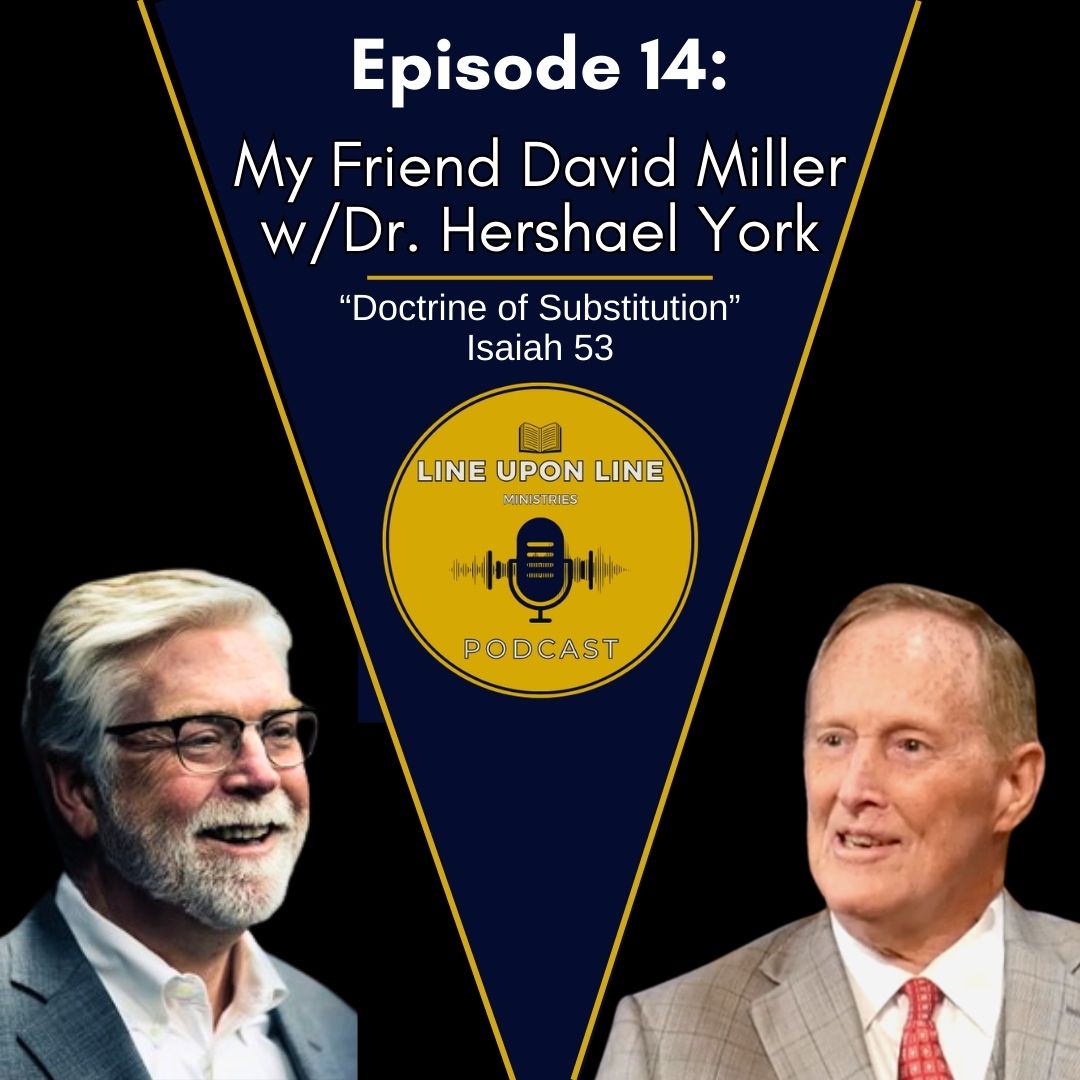
[00:00:20] Speaker C: Life of the local church. On today's episode, we have Dr. Herschel York with us for an interview as well as another classic sermon by Brother David Miller From Isaiah chapter 53 on substitution.
If you're new to our podcast or our ministry, I would encourage you to check out our website, www. Lineuponlineministries.com.
there you'll find an archive of Brother David Miller's sermons, outlines, things like that.
You'll also find other expository ministry resources there. So go there and check it out. Also go and follow us on our social medias, on Facebook and X and YouTube and all those things. Check out the, the clips and videos that are hopefully encouraging to you and be sure to share those with others who you think they would be an encouragement to as well.
Well, let's jump into the interview with Dr. Herschel York.
For those who don't know Dr. York, and I'm sure there are very few who are listening to the podcast who don't know who he is. Dr. York is Dean of the School of Theology at the Southern Baptist Theological Seminary. He is pastor emeritus of Buck Run Baptist Church, and he also hosts a podcast which we would highly recommend called pastor. Well, Dr. York is not only an expert in the field, a practitioner of expository ministry, but he's also a long time friend of Brother David Miller. And so this interview was a wonderful opportunity to get to hear some of his stories and his thoughts of Brother David over the years.
This interview was a long and fruitful interview. So we're going to show part one in this podcast and then part two in next month's podcast. Enjoy.
[00:02:26] Speaker B: Good morning, Dr. York. How are you, sir?
[00:02:29] Speaker D: Well, I'm doing well. I'm laid up. If you could see right now, got my, you know, I just had ankle replacement surgery.
I saw that and so I, I am drawing on my inner David Miller.
That's good. That's very good. How to control my environment when I have no control.
Yeah.
[00:02:55] Speaker B: Now this was, you said ankle replacement. Is that what it was?
[00:02:59] Speaker D: Yeah, yeah.
[00:03:00] Speaker B: Okay. Yeah, I saw that on Facebook and been praying for you.
Recovering. All right. Just, yeah, hardest part, just trying to stay, stay immobile and not.
[00:03:10] Speaker D: Yeah, that, that is. I have no weight bearing on it for like six first six weeks.
Got about three and a half more weeks of that to go.
I'm in a boot.
You Know, I can't even do physical therapy until week eight, so.
[00:03:29] Speaker A: Wow.
[00:03:29] Speaker D: It's not like a hip or a knee where they, they get you up almost immediately, you know, and you're doing stuff with the ankle. It's exactly the opposite. Don't do anything.
[00:03:39] Speaker B: Oh boy. Well, it's a good thing you have someone like Tanya as a help mate.
[00:03:43] Speaker D: There she is. Incredible nurse and, and helper.
[00:03:49] Speaker B: Well, praise the Lord. Well, Dr. York, I thank you for your time this morning. I'm glad you're, you're, you know, not able to move because that gives me an opportunity to, to settle you down and get on a call. But I'm not happy. You're, you're not do it. You know, you're not feeling well. But it does help make this opportunity a little easier.
But anyway, I, I, I wanted to get with you for a while. Now I know you have seen that we've kept the line upon line ministries going here and doing the podcast and all that kind of stuff and you are a long, long time friend of David Miller.
He would talk about you. I, I was only his pastor for a couple years, but I heard some stories about you and, and how much he loved you and, and all the, the time spent the decades of friendship and ministry and so I'm really excited to get you on here and just be able to talk about David, your relationship with him and your friendship with him ministry over the years. I really have no real agenda except just to let you share whatever you'd like to, to talk about with, you know, about David and then if we have time, we can, you know, talk expository ministry in general or some of that kind of stuff. But sure, I'm glad to, I've been, I've been real encouraged by you personally.
We've actually my first introduction to Dr. York was at Mid America Baptist Theological Seminary in my preaching class. Dr. Seal had us read this book, Preaching with Bold Assurance and like, who's this Herschel guy? But that was 2000, wow, 11 or something like that now.
But I've heard you speak over the years and been very encouraged by your ministry. Your podcast, Pastor well, has been a great encouragement to me personally. I know it is to so many out there. But thank you. Grateful for your ministry, brother, and grateful for your time this morning. I'm just glad that your ministry overlapped with Brother David. So I have a reason to call you and, and, and, and, and talk with you. So, so like I said, we, it's wide open here and we can, we can Discuss whatever you would like to regarding Brother David. I mean, I guess just to get us started, how did you, how did you meet Brother David? How did that all begin?
[00:06:23] Speaker D: Well, I was, I, I had done a.
Both an undergraduate degree and then a master's degree in Greek at the University of Kentucky. I was on staff at Ashland Avenue Baptist Church in Lexington.
And you know, seminary was really not a part of my background. I grew up pretty much independent Baptist. There were guys that had been in the SBC but had pulled out largely because of the liberalism of Southern seminaries. Like, you know, they're just so far gone it'll never come back. And my dad was among that group. He'd grown up Southern Baptist at Ashland Avenue actually, and they, they had left the sbc.
So, you know, there was an anti seminary education bias. There was just a suspicion of all seminaries.
And I, I knew I wanted to get a PhD. I was trying to figure out where to go. Nobody was really encouraging me in that. I was looking around and a friend of mine, Jim Orrich, who I grew up with, I've known Jim literally my entire life.
And he had, he and I, I mean, we'd both been youth pastors in Lexington and then serve a year ahead of me. He went to Mid America Seminary.
He came back to Lexington and came to see me and he brought me a tape of David Miller preaching on the church's founder at Mid America's founders days.
And I heard it.
He also introduced me to Tom Nettles, to the work of Tom Nettles.
And I read by his grace and for his glory and Baptist in the Bible.
And here was a seminary that employed Tom Nettles and had this guy David Miller preach. And I went, well, I'll be at home there because I resonated with both of those, those guys.
So May of 87, we backed up and we moved to the Memphis area. We actually lived across the river in Marion, Arkansas.
And my very first founders days there at Mid America, they, they back then they had David Miller preach every year. As long as, yeah. Degree Allison was alive. I think they had him preach every year.
And I heard him preach in person and I met him and you know, I was just blown away by him. It's just phenomenal is seeing him preach.
He could stand in those days, Bill, Bill Williams would come up on the platform and stand him up.
He'd sort of lock into place and he preached. And at the end, Bill would bring the wheelchair behind him and he would just collapse into it. I mean, it was unlike Anything you ever saw. Wow. And you held your breath every time. And David would have some funny lines about it. You know, Bill Williams had a lot of pull with me and stuff like that.
And, you know, I talked to him that very first Founders Days. You know, I'm just a seminary student. He was kind and encouraging.
I ended up, a year later, got called to be the youth pastor at First Baptist Church of Marion, Arkansas, right there where we had moved. We. We had moved to Marion. And within months of me becoming a youth pastor, the pastor resigned, and I became the interim pastor and the pastor. It was really during that time I was both interim pastor and youth pastor that I invited David Miller to come hold. You know, we called it a youth service, but it was just a big service inviting all area churches to come. We packed out the place, and he and Bill came and ate supper with Tanya and me. And, I mean, we were poor. There's no other word for it. We were broken. And Tanya served brown beans and cornbread, and David and Bill acted like it was the most delicious, luxurious meal they'd ever eaten. They were just so kind and gracious.
And David, he just took an interest in me. And they were planting, or planning on planting Tumbling Shoals.
Yeah, at that very time.
[00:10:48] Speaker C: That would have been.
[00:10:49] Speaker B: Right, that time. Yeah.
[00:10:49] Speaker D: And he.
He talked to me about it, if I might be interested in this.
And I was like. And I. I told him, no. What I think's going to happen is Brother Range pastor at Ashland Avenue is going to retire. And I think they'll call me back as pastor.
And that is, in fact, what. What ended up happening. And I was pretty certain of it.
And I just. I was getting other offers and things from time to time, and I was. I was pretty focused.
And so he said, well, if you think of anybody, let me know. Anyway, we just. We struck up a friendship.
When I did get called back to Ashland Avenue, I had David come preach for me there. We ended up spending time together. You know, I'd have him every year, and then he's. He introduced me to Al Moer.
So, yeah, the. The reality is my life changed because of David Miller. I mean, you look at me today, I'll be 66 in March.
And, you know, for 29 years, I've been at Southern Seminary. And that. That is in a very real sense, because David Miller, I. He was a trustee at Southern Seminary when they called out Mohler as the president, and he called me, I was pastor in Ashland Avenue. They called me back, you know, and he said, oh, you're going to love this guy. We called to be the president, said he's a dandy. I'll never forget him saying that he's a dandy. He said he believes the abstract of principles, including Article 5 on election.
And I went, you're pulling my leg. I mean, it was unthinkable.
[00:12:30] Speaker A: It.
[00:12:31] Speaker D: It was unthinkable that they would actually get somebody in Southern Seminary who really believed what Boyce and Broadus believed.
And the rest is history. You know, they call Al Mohler. I actually got Al Mohler's number from David and famously called out both Al.
Al and I have told this story many times that I called him. I was the only pastor in Kentucky who called him and said, I might be the only one, but there's at least one pastor in Kentucky who. Glad you're coming. Because he was Persona non grata in Kentucky. Man. It was a different landscape then.
And, you know, he came in 93. I didn't meet him face to face till 96. And David introduced us face to face at the, at the sbc.
He invited me to come preach in chapel.
At chapel. After chapel, we went to lunch. I invited him to come preach at Ashland Avenue that Sunday night.
He came over, we would pack it up. We had three Sunday morning services, so we had a full house. Sunday night he came in and he saw this vibrant church on Sunday night. Mohler couldn't believe it. But within months, we were talking about me coming to Southern Samaritan faculty. And it was, it was, it remains the hardest decision of my life.
I don't usually struggle with decisions, but I struggled with that one. But anyway, I go to. I ended up going, you know, in 1997, I, Tom Shriner, Tom Nettles, Bob Stein and Greg Wills joined the faculty. And it was a huge class. And it was sort of when you knew it was over, when Mohler, bringing in five just died in the wool. Conservative inerrantist like that, even reformed guys, sure, it was over. So, I mean, how do I quantify what David Miller's meant in my life? You know, there's no, you take David Miller out of my life. I don't know where I am or who I am, frankly. That's just, that's just the reality of it. He's one of those that God has used most effectively and graciously in my life.
[00:14:38] Speaker B: Yeah.
So, I mean, fascinating story there. I. When, when David shared some of these things with me, it was, it was, it was kind of, I mean, honestly, just surprising the, the impact he had from behind the scenes in the board and, and all that kind of thing to see where Southern was bringing in Al and you guys.
I mean, Obviously the last 30 years is, is radically different than, than very different.
[00:15:06] Speaker D: I, I will add, and I'm happy.
[00:15:08] Speaker B: To call you the Southern Baptist Theological Seminary.
[00:15:11] Speaker C: Just like.
[00:15:12] Speaker D: Well, Dr. Al, it's the name. What can I say? It's the name.
I will. I will also add that. So during that time, David Miller is also. While I'm pastor National Avenue, he's invited me to come to Arkansas a lot. Yeah. He was the director of missions of the Little Red river association at the time. They would have a summer camp and he'd have me be the speaker at the camp and then stay a few days and Heber Springs and we'd go. We did everything, man. I mean, you know, we'd go four Wheeling.
He had a pontoon boat. We go out boating. He literally taught my son Seth how to ski when Seth was 9 years old.
By merely breaking it down and describing it. David could describe, he could break down anything exactly how to do it. And he would very meticulously describe what you need to do step by step.
And he put. We put drop Seth in the water with a pair of skis. David described to him exactly what was going to happen, what you needed to do. Seth gets up, I think, his first time, and ski.
And of course, Seth would later work for David for a year, travel with him and care for him. And that's a massive part of Seth's life.
And then David, he started doing the Exposure Preaching conference.
And I don't know, maybe three or four years after he started that, then he asked me to come, start being a part of it. And I did for about 20 years. I suppose I don't.
A long time. So, you know, our families were getting closer in that time. He and I were getting, you know, one of the great blessings of my life is that I have gotten to my heroes, have become my friends.
I can say that about Adrian Rogers, Alistair Begg, David Miller. These are guys that I looked up to and they had a profound impact on me. By the grace of God, they became very dear, close friends.
And nobody more so than David. I mean, we were. We're close. We. We went through each other's successes, failures, heartaches, tragedies. We went through it together.
And, you know, I mean it. So it wasn't just ministry. We're doing fun stuff together. We were going places together and, you know, we'd preach together, we'd play together, you know, it was just a lot of. He was. He was one of the most fun guys ever.
[00:17:53] Speaker B: What were some of those things, just as friends you did. I know some of the ministry things, but, I mean, I know he was into hunting. Was that something you guys did or was. Was it different for you?
[00:18:04] Speaker D: We did. No, we. We hunted and different places. Especially he had. He had a deer camp down in Duck Hill, Mississippi, down there on the Delta. And I'd go with him there in Arkansas, around the place there. We were big into the four wheeling. We'd come there in the summer, so a lot of times it wasn't hunting season when I could be there, but we'd go Four wheeling and, you know, we literally would tie him on the back and he. He had a seat. So he is sitting up ahead, taller than me. His head would literally be higher than my head. And I. Going through the woods. I remember a vine was swinging down, it was hanging down the trail ahead. And I hollered back at him, I said, hey, duck. He goes, son, I haven't ducked in 20 years.
Last minute I. I remembered that, oh, you can't duck.
[00:18:58] Speaker A: You gotta hit the brake.
[00:19:00] Speaker D: And Josh and I, I mean, they were.
They were putting in the bypass around Heber Springs, and that was just all. Then Josh and I got four wheelers.
We go right all over that Rock Products road and all through the woods there, the big old piney woods.
And we just, you know, we just had a blast together, you know, Four Wheeling, fishing, you know, fishing, hunting, just playing. And then Josh was playing ball. You know, we come see Josh's ball games and, you know, it just. Just did stuff friends do.
[00:19:44] Speaker B: Yeah, well, I love hearing those kinds of stories that, you know, obviously I only got to know him for a couple years, but, you know, so I appreciate, appreciate you sharing some of your insight here.
[00:19:57] Speaker D: This.
[00:19:59] Speaker B: And I. I never knew Josh before, you know, his wreck. Obviously, that was a long, long time ago. But, you know, to. To hear about what he was like as a kid even is. Is fun to hear as well. Just.
[00:20:10] Speaker D: He was. Joshua's a black. He was just.
I mean, a tough kid, you know, I mean, he. It was funny. Again, David, who was so limited physically, there was never anybody more in control than David Miller. In fact, I used to joke, I call him a control freak. I say, you're a control freak.
And there is some truth to that, that to compensate for his lack of physical ability, he just was always in command, you know, and stuff had to be his way.
And. And he was always also convinced he was right and he normally was. Again, he could just break stuff down, what you had to do. It would be exhausting to be with him long because it had to be his way.
[00:20:57] Speaker A: Again.
[00:20:57] Speaker D: He was often, usually right. But it could, it could, it could wear any. I mean, Bill Williams, who was with him, I don't know how many years. The years and years and years. Yeah, a long time that he, he will get us special reward in heaven because he was just so humble and gracious and David, to just get on your last nerve when I, I'll tell you, like, when Seth, my son, traveled with him for a year, one time they were on the road, I want to say, 30, 40 days straight. It was just relentless. And it, and toward the end of this swing, they'd just been all over the country and, and they would get deer hunting and elk hunting and stuff in there, but they're still gone. They're living, they're living out of the, the RV or whatever.
You know, David required a lot of care. So for. Seth is driving all day, getting somewhere, setting up. He's having to attend to David's physical needs. He's having to take care of the rv, arrange logistics, all this stuff. It's exhausting. And he said to David, driving down the road, he said, brother David, this is. It's been a long, long stretch here, you know, I mean, I'm pretty tired. And David looked at him like, what are you talking about? He said, well, son, I've been right here beside you the whole way.
And you know, his, his lack of sympathy with anybody who even remotely whined.
There was no whining around David Miller. You just, no, you just better shut that up because he could, he could top your stories, how rough you had it, and he just would look at you like, oh, he's, he's like, if there's one thing I hate, it's a whiner, you know, when a preacher wines. You know, I heard that speech a lot.
Yeah.
[00:23:00] Speaker B: That'S good. Oh, man.
Yeah, he definitely, you know, if he, if he was speaking or he was talking, you, you definitely, you, you took what he said because, I mean, what.
[00:23:12] Speaker D: Are you gonna do?
[00:23:13] Speaker B: You can't, you can't say, you know. Well, you don't know what it's like, buddy. You don't know what it's like.
[00:23:19] Speaker D: I mean, his, his life was so complicated. People have no idea just what he had to do to get dressed in on a Sunday morning before church. You know, if he's preaching an 8:30 service, you know, how early, he had to get up and then. Oh, hunting. That's the fact that this guy insisted on hunting. And like day when Seth worked for him, he'd have to have him in the deer stand before five o' clock in the morning. That means they gotta get up at three.
[00:23:47] Speaker C: Yep.
[00:23:48] Speaker D: You know, go through all they got to do, tie him on the back of a four wheeler, get him up in the woods, get him in position, get his gun locked and loaded and all that and get out of there before the deer are stirring.
I mean, it was complicated. It was a lot to it. But that just shows you how, how much he loved it. And he was not going to miss out on life because of his disability. He just wasn't.
He was going to figure out a way to do it and to make it work.
That's right. And you know, he.
I'm sure he had moments of wondering, why me? But he never voiced it.
He just figured out a way to deal with it and he did what he had to do and. But he did not have patience with people who didn't approach life the same way he did. That's just, that's true. He had no room for people who griped, groaned and complained.
Yeah, he, he had a lot of.
[00:24:52] Speaker B: Grace towards people, but not, not people who complained in that way.
[00:24:56] Speaker D: No, that's exactly right. Yeah. Yeah, yeah. If you came to and you admitted you were struggling or something, you know, sure, yeah. I mean, but he, anything he could do and needed to do, but if you came in there with your, your attitude was like, woe is me. He had no room for that. It's like.
[00:25:16] Speaker B: Nope, not at all.
[00:25:18] Speaker D: Yeah. I mean, you think, you think about the difficulty, you talk about the challenge of his life and then I'll never forget. I can tell you exactly where I was today. I got the phone call. He called me to tell me about Josh's accident.
And you talk about increasing the complication of their lives.
Suddenly, you know, he and Glenda were living alone. Now they had another patient and Josh is a big man. Here's Glenda. Yep. With two guys, six four, six five and above to care for.
I just look at that and think, who, who does that? Who can do that? I mean, they did get some help and had some help. But the relentlessness of it for Glenda, just caring for David and Josh and then getting the head help, different people who helped him. But again, from Seth working for him for a year, I mean, I just know the absolute unfailing nature of the needs that they had to meet. Every day. And their lives went from really complicated to far more complicated.
And yet, you know, David was not going to be passive.
I remember when Josh was in the hospital in Little Rock for so long, and David's, you know, they're driving down there every day or setting up the RV down there, and he just. He took Rispa as his model, you know, who set a watch over the bodies of her sons after the gibeonites put them to death with David's permission.
And she beat back the.
The forces of death. She beat back the buzzards and the coyotes and everything else until, you know, the harvest time. And then David allowed them to be buried. He took her vigil as his standard, and he said, I'm just going to set a watch over my son.
He learned everything he needed to learn about spinal injuries. He could talk with surgeons in technical details.
He learned what he needed to learn about rehabilitation.
And I've just never seen anybody more intentionally parenting than he did.
Parents a lot of times think, oh, your kids grow up, they turn 18, you're done.
You're never done. You're never done. And, boy, David Miller and Josh would be the first to tell you, was never done parenting to the day he died. You know, the. The story of the way he.
He woke up in the hospital room and told Josh he was ready to go, for them to let him go, even that. I go, you know, what a David Miller story that he's like, let me die.
You know, I'm. I'm ready to go. And that's just the way he approached everything. He figured out what needed to be done, and he did it. And he did not complain about it. He just.
Just did whatever it took.
And that's the way he went about his preaching. It used to irritate him when people, you know, he would memorize a scripture. He could not hold the Bible right.
[00:28:47] Speaker B: Yeah.
[00:28:47] Speaker D: So he had to memorize the scripture and memorize his sermon notes and. And it bugged him when people would say, oh, I wish I had your gift of memory.
He would get that.
He say. As if it was.
[00:29:04] Speaker B: If it was a spiritual gift.
[00:29:06] Speaker A: That was just.
[00:29:07] Speaker D: Yeah, he said, I used the grind it out method.
[00:29:10] Speaker B: There you go.
[00:29:14] Speaker D: And grind it out. And there was. You know, there was no.
He had no gift for memory. He had. He just sat down and he read it and read it and read it, and he would memorize it a phrase at a time, sort of diagramming it in his mind and putting it together until he had the whole thing memorized. And there it took him hours upon hours.
It wasn't an easy thing for him. And that's why when people would just sort of excuse themselves, oh, I can't memorize Scripture. You know, that irritated him, acting like he had a gift, but he didn't have a gift. He would also.
He would sort of privately to me talking these preachers who think they're doing something reading through the Bible once a year. You know, he read through the Bible usually at least five times a year, and he just was in the word of God all the time.
And he lived it, he loved it, he preached it. And so whether you're talking about hunting or sponsoring preaching, David's plan of attack was the same all the time. It was just, you do whatever you have to do to do it with excellence and do it well, do it right.
And that's all there is to it. No, no shortcuts and no complaining about it. And that's the way he went about everything.
[00:30:38] Speaker B: Right? Yeah, yeah. He, he.
I remember him telling me that when I, when I was talking to him about his, his memorizing scripture and, you know, just in, in awe of that. You know, like everybody is.
And, and him just. No, you just have to sit down and do it.
[00:30:58] Speaker D: Yes.
[00:30:58] Speaker B: There's nothing special about this. It's just I, I've spent more time doing it than anybody else. There's just, you know, I'm not sitting there on Facebook or on tv and, you know, I'm, I'm. Yeah, I'm in the Word. I'm in the Word. I'm in the Word.
But yeah, that, that, that comes up quite often now. It's been a blessing this last year to, to take on the line upon line stuff. And so a lot of people will comment or message us or tell us, you know, stories or things about David or they'll comment about his, you know, most commonly of, of his blessed memory. And, And I just have to keep telling him. Nope, that, like, yeah, that's not how it was. That is.
[00:31:37] Speaker D: He.
[00:31:37] Speaker B: He would tell you himself. That's. You just. You have to work at it. And.
[00:31:42] Speaker D: That's Right.
[00:31:43] Speaker B: But what a test. But what a testimony to, to, to us as, as pastors, as, as not even just pastors, just church people.
You want to know the word, you want to memorize the Word, you got to get into it, do it.
[00:31:55] Speaker D: That's right. There is no shortcut. That's right. There is no shortcut. It's. It takes time and there are other things in your life you got to cut out or put on a back burner in order to put knowing the word of God on the front burner. And it just really is. It's simple. Now, simple and easy aren't the same thing.
It is simple. It's not easy, but it is simple. And it's just. You just do it. And he did it. That's the way he sway went about everything.
[00:32:23] Speaker C: Yeah.
What a joy it is to hear from Dr. York on his friendship with brother Miller over the years.
Look forward to part two next month in next month's podcast.
Next up, we're going to go to the classic sermon by brother David Miller. This one as he preached from Isaiah 53 on substitution.
[00:32:50] Speaker A: I invite you to turn please to the Old Testament, book of Isaiah, chapter 53.
My subject tonight and Saturday morning is the doctrine of substitution and satisfaction.
I have chosen to join these two subjects in one sermon.
There is much overlap of these two doctrines and so I propose to preach one sermon in two parts.
I have a six point sermon and I'm going to give you three of them tonight and three on Saturday morning.
What do you think about that?
Have you found our text?
Who hath believed our report?
And to whom is the arm of the Lord revealed?
He shall grow up before him as a tender plant, and as a root out of a dry ground.
He hath no form nor comeliness.
And when we shall see him, there is no beauty that we should desire him.
He is despised and rejected of men, a man of sorrows, and acquainted with grief.
And we hid, as it were, our faces from him.
He was despised, and we esteemed him not.
Surely he hath borne our sorrows and carried our griefs.
Yet we did esteem him stricken, smitten of God and afflicted.
But he was wounded for our transgressions.
He was bruised for our iniquities.
The chastisement, the punishment of our peace was upon him.
And with his stripes we are healed all. We, like sheep, have gone astray.
We have turned every one to his own way.
And the Lord hath laid upon him the iniquity of us all.
He was oppressed, and he was afflicted, yet he opened not his mouth.
He is brought as a lamb to the slaughter.
And as a sheep before her shearers is dumb, so he openeth not his mouth.
He was taken from prison and from judgment.
And who shall declare his generation?
For he was cut off out of the land of the living.
For the transgressions of my people was he stricken.
He made his grave with the wicked and with the rich in his death, because there was no violence in him, neither was any deceit in his mouth.
Yet it pleased the Lord to bruise him.
He hath put him to grief.
When thou shalt make his soul an offering for sin, he shall see his seed.
He shall prolong his days, and the pleasure of the Lord shall prosper in his hands.
He shall see of the travail of his soul, and shall be satisfied by his knowledge.
Shall my righteous servant justify many, for he shall bear their iniquities.
Therefore will I divide him a portion with the great, and he shall divide the spoil with the strong, because he hath poured out his soul unto death, and he was numbered with the transgressors, and bare the sins of many, and hath made intercession for the transgressors.
Hallelujah, and glory to God.
Now I want to state for you the doctrine of substitution and satisfaction.
God, taking into account our sin and his holy justice, has taken the initiative to redeem fallen man.
He must either punish our sin by punishing us, or he must deal with us through a substitute.
And God, in His sovereign plan of redemption, has appointed his own Son to be that substitute.
He has taken the sins of his people and placed them upon His Son.
Christ, who knew no sin, became sin for us. That is, he took the blame and he bore the wrath that should have been upon you and me.
He took it upon himself, this satisfied holy justice and made it possible for God to be just and the justifier of every sinner who comes to him through Christ.
This is the gospel that we proclaim.
Now, by way of further introduction to the text, let me tell you that in verses 2 and 3 we see his unattractive position in society.
He is not going to be elected most likely to succeed.
He is not going to when Mr. Universe.
He has no form nor comeliness.
There is no beauty about his physical appearance, his unattractive position in society.
In verses 4 through 6 we see his unprecedented participation in suffering.
He was wounded for our transgressions. He was bruised for our iniquity.
No man ever suffered like Jesus.
His unprecedented participation suffering.
In verse seven we see his unusual portrayal of submissiveness.
He was oppressed, and he was afflicted, yet he opened not his mouth.
What an example he has set, we ought to follow in his steps.
In verses 8 through 11 we have his unmistakable propitiation for sins.
God has made the soul of His Son offering for sin.
He bore the transgressions of God's people.
But in verse 12 we see another thing.
We See his unlimited power over Satan.
For God has raised him up and has divided him a portion among the great, and he shall divide the spoil with the strong. These are the things that we shall be looking into during these two sermons.
Now, here is Roman numeral number one.
I want you to see the indefensible wickedness of the sinner.
This text says several things about mankind.
It says that he is a sinner.
He is wicked.
He is iniquitous, ubiquitous.
He is a transgressor.
He is an existentialist philosopher.
He has turned to his own way.
He has said, we will not have this man to rule over us.
He will bow to no tribunal.
He will recognize no objective authority outside of himself.
He is foolish, like a sheep. He has gone astray.
If you have turned the television on to the news channels in recent days, you have seen much of the intellectual stupidity that characterizes the mind of the fallen man.
Just utter foolishness.
Stuff that just makes you shake your head in bewilderment, wondering, how can this be, that men do not have better perception? It is because of his indefensible wickedness. He will not have God to reign over him. He will not submit himself to the objective authority of Holy Scripture. He will be his own God.
But if this were not enough, the very pinnacle of depravity.
Or perhaps better put, the depths of human depravity are seen in the statements in verse three when it says, he, Jesus, the righteous servant, was despised and rejected of men.
He was despised, and we esteemed him not.
What greater expression of human depravity could there be than the fact that men heaped contempt upon the Christ of God?
They spat upon him, they mocked him. Ultimately, they nailed him to the cross and jeered and applauded in joy that the Son of God, God, had been crucified upon the cross.
And let us not in this room suppose that had we been there, we would have handled it differently.
You and I are not cut from a different piece of cloth.
You and I are made of no better stuff than this.
Sinners are we all indefensibly wicked, lewd, vulgar, profane, having turned to our own way and rejected the lordship of Jesus Christ?
Humbling it is, it puts us in the dust.
And yet it is the case with each of us.
But now I want you to see, secondly, in the sermon, the indescribable wrath of the sovereign.
There are several words in the Hebrew and Greek languages that have been translated from wrath in our English Bible. One of these is the Greek word thumos T H U M O S this word has in mind a person who is a hot head.
They fly off the handle, they lose their cool.
They fly into a fit of anger, uncontrolled and outraged.
Now, I know some Baptists that this word would appropriately characterize.
Do you know them?
They fly off the handle, they lose their cool.
They fly into a fit of anger, uncontrolled and outraged.
In fact, I know so many of them, I'm convinced that we ought to start a new denomination for them.
And I have selected a name for them.
We shall call them the General Convention of Thumas Baptist, known in the vernacular as Hot Heads.
But let me tell you something.
This word thumos is never even once used in the Bible with reference to God.
Whatever else we mean when we talk about the wrath of God, God. We do not mean that God ever loses his cool.
We do not mean that God capriciously runs off in a fit of anger, uncontrolled and outraged. That is not the God of the Bible.
There's another word in the Greek language, translated wrath.
In our English Bible, it's the word org.
And this word has in mind a swelling, a burning, a hot displeasure and holy disdain, a strong antagonism towards sin.
Now, there is this certain aspect to the personality and the character and the essence of the God of the Bible.
He is holy, infinitely pure.
And when men sin against him on the basis of his justice, God Almighty is moved against them in hot displeasure.
It is somewhat like the dam across the river.
When the concrete and the steel are in place, it causes the waters to back up, to swell into the nooks and turns and the coves and the creeks.
Today, as men sin, there is this swelling, this burning indignation in the heart of God.
Today there is a dam across that river.
It's not a dam of concrete and steel.
It is the dam of his patience.
It is the dam of his forbearance and his long suffering.
It is possible that men in their sin store up wrath against the day of wrath and indignation of God, which will result in eternal damnation.
Now, we find the notion of God's wrath in Isaiah 53 and verse 10 when it says, it pleased the Lord to bruise Christ.
He hath put him to grief.
When Jesus Christ died upon the cross, holy justice poured out its awful wrath upon the Son of God.
And let me tell you something about that.
When the smoke of the torment of the damned has ascended up forever and forever, it will not equal and it will not rival the awful Wrath of God that was poured out upon the sinless Savior, Jesus Christ.
And let me tell you further.
Only he who has apprehended the reality of God's wrath is overwhelmed by the magnitude of God's mercy.
This is where we stand.
Guilty before a holy God, before him who will not acquit the guilty before him whose anger is moved toward the sinner.
Not just move towards sin as a principle, but God is angry with the sinner every day.
Now that brings us to a third item we need to discuss the infinite wisdom of the Son.
I call your attention to verse 11 in our passage and the second statement. It says, by his knowledge shall my righteous servant justify many.
Now, I have read many of the commentaries and I have been somewhat surprised because most of them say that this passage is referring to that knowledge which a sinner must have in order to believe in order to be justified.
Now, hopefully none of us in this room would argue with with the fact that in order to be justified, you have to exercise faith.
And in order for you to have saving faith, you must have a proper object for that faith. That object must be the Lord Jesus Christ and his atoning work upon the cross.
There must be some information given in evangelism. Is that not a problem today?
Is that not the weakness of modern day evangelism?
It's as though we're afraid we're going to tell them too much.
I'm afraid we're telling them too little.
Give them some stuff to wrap their faith around, to build their hopes upon.
None of us reject that notion.
My question is, is that what this verse is saying?
You see, just because it's true in one portion of Scripture doesn't mean it's being taught in another portion portion of Scripture. It's the business of the preacher. It's the work of the interpreter to explain what this text is saying.
What does this mean?
By his knowledge shall my righteous servant justify many?
I believe it means that by the knowledge, by the wisdom which Jesus the Son possessed, he was able to resolve a seeming dilemma in heaven.
Do you know what an anthropomorphism is?
That's when we speak after the manner of a man.
Can we do that here?
Can we imagine for a moment that there is a dilemma in heaven?
God is holy, he is just, and his wrath is toward sinners.
Man is guilty without exception.
That's one side of the dilemma.
The other side is God is also a God of love, a God of grace and a God of mercy.
And these two ideas on the surface seem antagonistic they seem incongruent.
For if God in mercy would reach out to fallen man, if God in grace would forgive men, as some who reject the notion of penal substitution suggest, if God were to do that, then justice would speak up and justice would say, no, no, you cannot save him in grace and mercy and love because he is guilty.
And holy justice demands that sin be punished.
And besides, your truthfulness is at stake.
You have said, the soul that sinneth, it shall die.
The wages of sin is death.
It's appointed unto men once to die and after death the judgment.
You cannot save sinners strictly on the basis of forgiveness, grace and mercy and love, and violate holy justice in the process.
Are y' all getting any of this?
Now, what was to be done, that is a sizeable, that is an insurmountable task left up to us.
In fact, Thomas Watson in his body of divinity said it like, if God had left it up to us, we would not have had the head to devise nor the heart to desire salvation.
You want to know what happens when man tries to solve this dilemma on his own?
You have a Hinds 57 variety of isms and schisms, and they all do two things.
They leave the justice of God unsatisfied and they leave man yet condemned in his sin.
But glory, glory.
Jesus is a man of wisdom, the righteous servant of the Lord. God is a man of knowledge.
And here's what wisdom did.
Wisdom had a conversation with love.
This occurred in eternity past.
It is sometimes referred to as the everlasting covenant.
Wisdom said, love, would you be willing to give up the only begotten Son who knows no sin?
Would you be willing for him to be made sin for God's chosen people?
Would you be willing for him to take the blame?
Would you be willing for their guilt to be written on his account?
And when he in the fulness of the times shall come, made of a woman made under the law, and the sins of the people are placed upon him. Him, would you be willing for holy justice to pour out its awful wrath upon him?
And do you know what Love said?
Love said, if that's what it takes, that's what I'll be willing to give.
Now that solved half of the dilemma.
Love is willing.
And then wisdom had a conversation with justice and said, I have spoken to Love and here's what love is willing to do.
Love is willing to give up the only begotten Son, sinless, spotless and superlative.
Love is willing for him to die as a substitute for the people would you justice be willing in that moment to pour out your awful wrath that should have been upon the people, would you be willing to pour that wrath out upon the Son?
And Holy justice said, seeing the infinite worth and value of the Son as a sacrifice, I will be willing to pour out the last dregs of the fury of the wrath of God upon him.
And Paul has been systematically discussing all of this and the New Testament Book of Romans, and he has come now to chapter 11 along about verse 32, and he can no longer contain his jubilation. And so he enters into a doxology of praise, saying, o the depths of the riches, both of the wisdom and the knowledge of God, who hath been known the mind of the Lord, or who hath been his counselor?
Who would have ever dreamed that in order to save our sinful souls that God would have given his own Son, given Himself in fact, as an offering for sin?
Once I was straying in sin's dark valley no hope within could I see they searched through heaven and found a Savior to save a poor lost soul like me oh what a savior oh hallelujah.
His heart was broken on Calvary his hands were nail scarred his side was riven he gave his life's blood for even me.
I was guilty with nothing to say and they were coming to take me away but then a voice from heaven was heard that said, let him go and take me instead and I should have been crucified I should have suffered and died I should have hung on the cross in disgrace But Jesus God's son took my place oh to see the dawn of the darkest day Christ on the road to Calvary Tried by sinful men Torn and beaten Then nailed to a cross of wood this the power of the cross Christ became sin for us Took the blame bore the wrath we stand forgiven at the cross oh to see my name written in your wounds for by your suffering I am free Death is crushed to death Life is mine to live won through your selfless love this the power of the cross Son of God died for us what a love, what a cost we stand forgiven at the cross.
[01:09:25] Speaker C: I hope you've enjoyed this episode of the Line Upon Line Ministries podcast. If you have any questions or comments, or if you have any ideas for future episodes, please email me lineuponlineministriesmail.com and be sure to check out our website and social medias. Be sure to like and share this podcast if you believe it would be an encouragement to others. As always, God bless you as you continue to study and minister. God's word. Line upon line.
[01:09:56] Speaker A: Sam.